


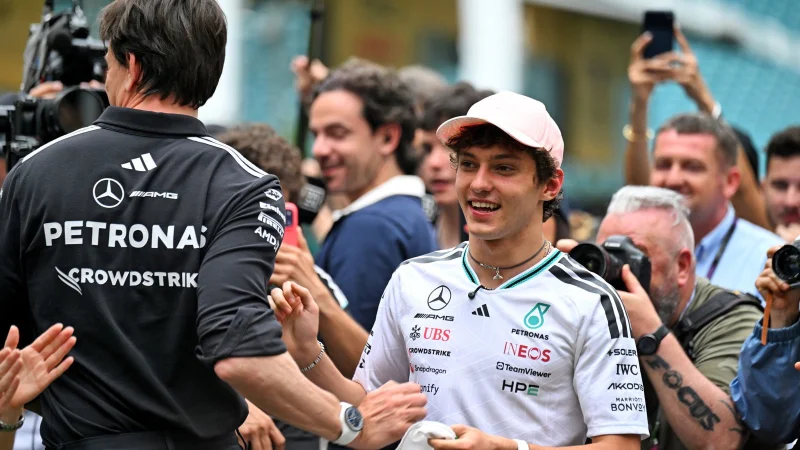
Toto Wolff has hailed Mercedes’ junior programme after Kimi Antonelli turned a fast start to the 2026 season into one of Formula 1’s most striking breakthrough runs. The teenager became the youngest pole-sitter, the youngest championship leader and the second youngest race winner in the opening phase of the campaign, while also becoming the first driver to convert his first three poles into victories at consecutive races.
Wolff said the early results matched what Mercedes believed it had seen for years. “When you look through his trajectory in karting and in the junior formulas, he was just outstanding,” he said. Antonelli’s rookie season had already shown its range: a strong start, a difficult European campaign in the middle and a strong finish. The latest surge has put him at the centre of the team’s long-term bet on its academy system.
The Mercedes boss said the junior programme was careful in how it handled Antonelli long before he reached Formula 1. During his junior career with the team, he was shielded from the media spotlight, with access limited during his Formula 2 season to official FIA sessions. Wolff said that approach was deliberate. “The junior programme is quite diligent, and if you look at his junior trajectory from mini karts all the way to F2, you see the pace and the speed,” he said.
That pace, he added, was only part of the job. Mercedes, Wolff said, gave Antonelli last year to make mistakes while continuing to mentor him and apply pressure. “Then it just needs the development, and we have given him that last year to make mistakes. And there’s more to come, but he has good speed [and] character traits,” he said. He also pointed to the way the young driver handles setbacks: “We needed to calibrate and continue to mentor him, whilst having pressure on him, but he just takes it so well. He is able to analyse it, but then not overthink it. He compartmentalises it, ‘Ok, I made a mistake. I put it away’.”
Wolff framed Antonelli’s rise as proof that the pathway was working exactly as intended. “When you think about what we said last year, it’s exactly how he has performed and how he has developed. He’s had these great ups, these moments of brilliance, and then moments where he was allowed to make mistakes,” he said. The result, in Mercedes’ view, is a driver who has moved from promise to production faster than expected.
But the same success now raises the stakes. Wolff said Antonelli has learned enough about the pressure of Formula 1, and about the attention that comes with winning so young, that the challenge is no longer talent recognition but management. “This year, at the start of the season, he has seen the grands prix, he has worked with the team, he knows the pressure that the media he puts upon him, but nevertheless, we just need to stay calm here, because such a success for such a young man at that stage, all of Italy will be on him,” he said.
For Mercedes, Antonelli’s rise is more than a feel-good story. It is the clearest validation yet of a system built to identify speed early, protect it from the noise and let it mature. The early months of 2026 suggest that formula has produced not just a prospect, but a driver already reshaping the front of the championship.
