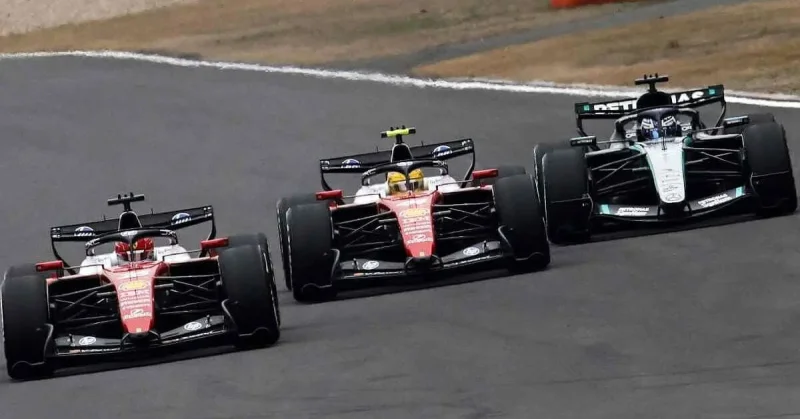
Scuderia Ferrari has started the 2026 Formula 1 season in a place few expected and still does not know exactly what it means. After four rounds, Ferrari sits second in the Constructors’ Championship with 110 points, 70 behind Mercedes, yet the team has also failed to put the SF-26 on the front row of a Grand Prix.
Charles Leclerc has carried much of the load with two third-place finishes, while Lewis Hamilton has added one podium. Leclerc also delivered a second-place finish in a Sprint race and another third-place result, and Hamilton claimed a third-place Sprint finish, giving Ferrari enough early results to stay in the title fight without looking like a team that has solved its problems.
The first major development step came at the Miami Grand Prix, where Ferrari introduced a package and a half of upgrades. The gains did not match what the team had hoped for. Both drivers have repeatedly pointed to the power deficit of the current Ferrari power unit, and Hamilton has said simulator-based setup directions have not translated cleanly to real track conditions. That leaves Ferrari in an awkward middle ground: better than last year in some respects, but still chasing a performance jump that has not arrived.
Pino Allievi, a veteran observer with more than 20 years on the Maranello beat, said the early season should not be read as a failure. “Nothing about Ferrari has disappointed me so far,” he said, adding that it is “a very good car in terms of on-track behaviour.” Even so, he said he had expected more from the Miami step and argued that Ferrari’s ideas on the SF-26 had already been copied by rival teams. He also said other teams, including Alpine, had extracted bigger gains from their own Miami updates.
Allievi’s defense of the program was not a blanket endorsement of every technical choice. He said the decision on the power-unit concept was made collectively by Ferrari’s entire technical staff and that it was not the moment to put Enrico Gualtieri’s group on trial. He also said he was “completely against ADUO,” making clear that his criticism does not extend to the project as a whole, but to the timing of the verdict being passed on it.
Francesco Cigarini, who spent more than 20 years working at Maranello, struck a similar note of guarded confidence. “As of today, there is no specific element that has disappointed me,” he said, and he added that compared with last year, “the car is more competitive.” In his view, Ferrari has already pushed out technical ideas and upgrades that rival teams noticed and adapted, enough to suggest that “the flow of innovation was unlocked again” and that Ferrari is setting the benchmark in some areas.
That is the tension in Ferrari’s opening act: the results are good enough to keep the conversation about a title challenge alive, but not strong enough to erase the unanswered questions around outright pace and development. Ferrari’s current position says the team is in the race. The lack of a front-row Grand Prix start and the unresolved power-unit gap say it has not yet joined Mercedes at the front of it.
Cigarini said Ferrari would be disappointed only if it failed to continue developing the car aggressively and effectively, because that would eventually drag it away from the championship battle. For now, the numbers say Ferrari is close enough to dream, but the development trend will decide whether those early points turn into pressure on Mercedes or another season of chasing from behind.