


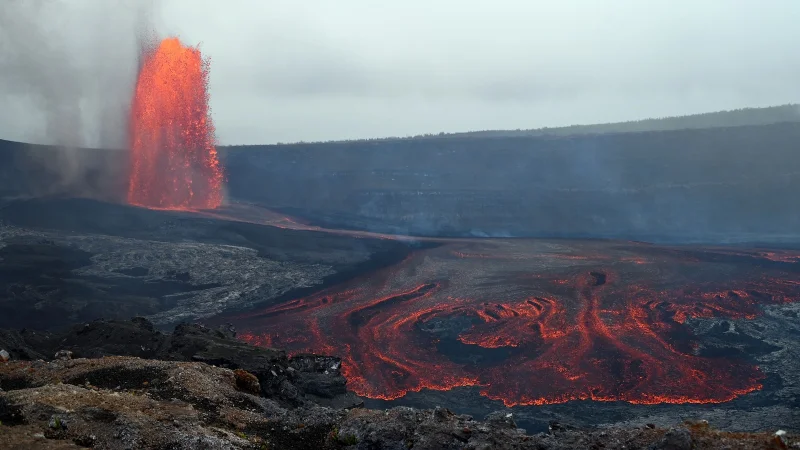
Kīlauea’s Halemaʻumaʻu eruption hit its 47th lava-fountain episode on Thursday, May 14, tying the volcano’s record for the most fountaining episodes ever recorded. The latest burst matched the total set during the 1983-1986 initial phase of the Pu‘u‘ō‘ō eruption, a benchmark that had stood for decades.
The current eruption reached that mark in about 1.5 years, far faster than the 3.5 years it took Pu‘u‘ō‘ō to get there. The pace has been striking not just for the number of episodes, but for how often they return. The average pause between bursts has been about 10 days in the ongoing Halemaʻumaʻu eruption, compared with 24 days for Pu‘u‘ō‘ō, about 18 days for Maunaulu and just 2 days between the fountain events at Kīlauea Iki.
The reason the comparison matters is that the Halemaʻumaʻu eruption is not simply a repeat of old Kīlauea behavior. It is an ongoing historic event that has given observers unusually close access to classic Hawaiian fountaining, while also producing a pace of activity that is faster than several of the volcano’s best-known eruptions. That makes the 47th episode more than a round number; it is the point at which the present eruption moved into direct comparison with the longest-view record of Kīlauea’s explosive lava displays.
Numbers from the U.S. Geological Survey Hawaiian Volcano Observatory show the current eruption is also being fed at a strong rate. Preliminary estimates put magma supply at about 5.8 cubic yards per second, or 4.4 cubic meters per second, roughly 25% more than the long-term supply rate. For comparison, the Pu‘u‘ō‘ō eruption’s supply rate was about 4.6 cubic yards per second, or 3.5 cubic meters per second. That helps explain why the present eruption has been able to keep returning in such regular fashion.
The historical backdrop is even wider. Kīlauea Iki, in 1959, produced 17 episodes and still holds the record for the highest fountain ever measured at just over 1,900 feet, or 580 meters, though that height lasted only about 10 minutes. The 1960 Kapoho eruption produced similar high fountains from the summit reservoir at lower elevation, and Maunaulu followed with 12 episodes in 1969-1970. Against that record, the current eruption now stands alongside the biggest names in Kīlauea history rather than outside them.
The wrinkle is that the old Pu‘u‘ō‘ō fountains were seen by very few people because the eruption was in a remote location in the middle of the East Rift Zone of Kīlauea. Halemaʻumaʻu has been a different kind of spectacle: an active, closely watched eruption in a more accessible setting, where each episode has been measured not only as a scientific event but as a public one. The 47th burst does not close the story. It answers the question of where this eruption sits in the record: tied for first, and still going.
