


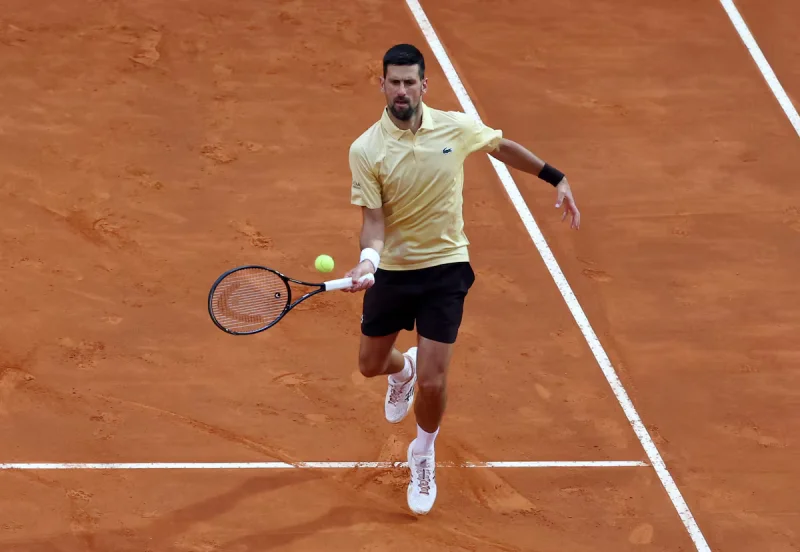
The French Open moves from qualifying into full Grand Slam mode this week in Paris, with the main draw scheduled to begin Sunday, May 24, and both singles championships set for the closing weekend at Roland Garros. Coco Gauff and Carlos Alcaraz return as defending champions, while Iga Swiatek, Aryna Sabalenka, Jannik Sinner and Novak Djokovic enter a tournament shaped by form questions, clay-court pressure and a wide-open chase for momentum.
Roland Garros Schedule Moves Toward Main Draw
Qualifying began Monday, May 18, giving lower-ranked players a final route into the field before the main event starts. The French Open main draw runs from Sunday, May 24, through Sunday, June 7, at Stade Roland Garros.
The tournament remains the second Grand Slam of the tennis calendar and the sport’s defining clay-court championship. Matches are played over 15 days, with day sessions starting in the Paris morning and night sessions placed on Court Philippe-Chatrier.
For viewers in North America, the early-round schedule means morning and afternoon coverage in ET. The men’s and women’s singles draws are expected to shape the first-week storylines immediately, especially if dangerous floaters land near defending champions or top seeds.
Coco Gauff Returns As Defending Champion
Gauff comes back to Paris with a different kind of pressure after winning the 2025 women’s title. Her victory over Sabalenka last year gave her a second Grand Slam singles crown and changed the way every clay-court result since has been judged.
The 2026 buildup has been mixed but encouraging. Gauff dealt with illness and inconsistency during parts of the clay season, yet she still reached another major final-stage tuneup in Rome. Her serve remains the key technical issue. When it holds up, she can use her movement, backhand and defensive range to turn clay matches into long, physical contests that favor her athleticism.
Gauff has also tried to frame this year’s tournament as a fresh campaign rather than a title defense. That mindset matters. Paris has rewarded players who can absorb pressure over two weeks, and the defending champion will face the added burden of expectation from the first round.
Swiatek Seeks To Reclaim Her Paris Aura
No women’s player in the current era is more closely linked to Roland Garros than Swiatek. She has won the French Open four times and built much of her career identity around clay-court dominance in Paris.
This year, however, she arrives without the same aura of inevitability. Swiatek has not won a clay title since her 2024 French Open triumph, and her 2026 clay swing included uneven results, coaching changes and sharper competition from the top of the women’s game.

Still, she remains one of the most dangerous players in the field. Her heavy forehand, court positioning and ability to rush opponents on clay have repeatedly translated well in Paris. A semifinal run in Rome suggested that her game is not far away, even if the gap between Swiatek and the rest of the field has narrowed.
Sabalenka, Rybakina And Svitolina Add Depth To Women’s Field
Sabalenka enters as world No. 1, but clay remains the surface where she has the most to prove. Her power can overwhelm opponents anywhere, yet recent injury concerns and uneven clay results have made her French Open outlook less certain than her ranking suggests.
Elena Rybakina arrives with a strong 2026 season behind her and a chance to push for the top ranking if she goes deep in Paris. Her serve and flat groundstrokes are not traditional clay-court weapons, but when she controls first-strike exchanges, she can shorten points even on slower courts.
Elina Svitolina is another major name to watch after a strong clay run. Her defense, experience and ability to absorb pace make her a difficult matchup in best-of-three sets. Jessica Pegula, Mirra Andreeva and Marta Kostyuk also enter the tournament as players capable of disrupting the expected order.
Alcaraz Leads Men’s Storylines As Sinner And Djokovic Loom
Alcaraz returns to Roland Garros as the defending men’s champion and one of the clearest favorites. His blend of speed, touch, drop shots and explosive forehand makes him uniquely suited to clay. Paris also gives him the stage where his improvisational style can become a sustained advantage rather than just highlight material.
Sinner remains a central contender because of his baseline consistency and hard, clean ball striking. If his movement and endurance hold through long clay rallies, he has the game to challenge anyone in the draw.
Djokovic’s role is more complicated. His history at Roland Garros commands respect, but the week-to-week dominance that once made him the automatic center of every major conversation has become less certain. Even so, no draw wants to see him early. Best-of-five tennis has often given Djokovic time to solve opponents who look stronger on paper.
Why This French Open Matters Now
The 2026 French Open arrives at a moment of transition on both tours. The women’s field has no single overwhelming favorite, despite Gauff’s title defense and Swiatek’s Paris record. The men’s draw has a younger center of gravity with Alcaraz and Sinner, while Djokovic’s presence keeps the old era in the frame.
The next major developments will come from the draw, early injury updates and the first weekend’s matchups. In Paris, the opening rounds often reveal whether a contender is merely surviving the clay or truly building toward the second week.
For now, Roland Garros begins with familiar names and unsettled questions. Gauff and Alcaraz hold the trophies, but the 2026 French Open looks ready to test whether last year’s champions can turn defense into dominance.
