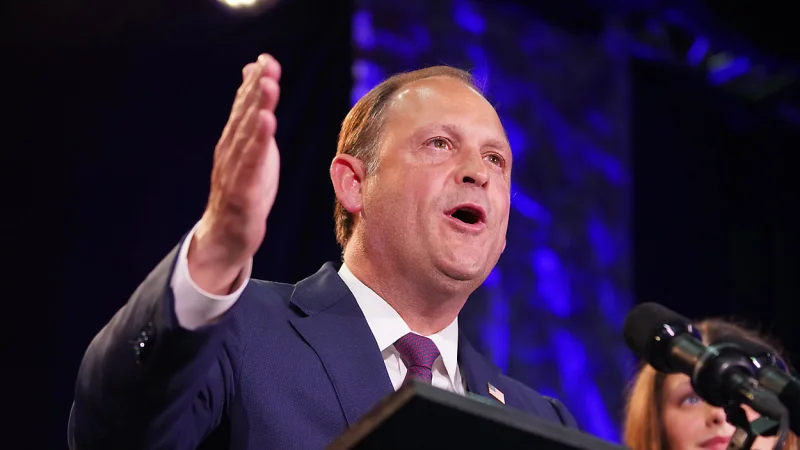
Andy Barr won Kentucky’s Republican primary for U.S. Senate, giving the congressman the GOP nomination for the seat Mitch McConnell has held for four decades and setting up a November race against Democrat Charles Booker. The May 19 primary marked a major generational turn in Kentucky politics, with McConnell retiring, Daniel Cameron falling short and both parties now moving toward a general election that Republicans enter as the clear favorite.
Barr Defeats Cameron In Republican Primary
Barr’s victory ended a competitive Republican race that had been shaped by McConnell’s retirement, Donald Trump’s influence and the question of who would inherit one of the most prominent Senate seats in the country. Barr, who represents Kentucky’s 6th Congressional District, moved from a House seat centered on Lexington into a statewide contest with a message built around conservative policy, party unity and alignment with Trump-era Republican politics.
Daniel Cameron, the former Kentucky attorney general and 2023 Republican nominee for governor, began the race with strong name recognition and deep ties to the party establishment. Early Kentucky primary polls often showed him ahead or near the top of the field. But Barr closed the gap over the campaign and ultimately won the nomination.
The result was also a setback for Cameron’s effort to rebuild after losing the governor’s race to Andy Beshear in 2023. Cameron had argued that he represented the next generation of Kentucky Republican leadership, but Barr proved better positioned in the final stretch of the Senate primary.
McConnell’s Retirement Reshapes Kentucky Politics
McConnell’s decision not to seek another term created the first open race for this Senate seat since the 1980s. He has represented Kentucky since 1985 and served as one of the most powerful Republicans in Washington, including a long run as Senate Republican leader.
His retirement did not simply open a seat; it changed the structure of Kentucky’s Republican politics. For years, statewide GOP candidates had to decide whether to run inside McConnell’s orbit or against it. In 2026, the leading candidates treated his legacy carefully, acknowledging his influence while avoiding a campaign built around defending the old party establishment.
That balancing act reflected McConnell’s complicated standing with today’s Republican base. He delivered federal influence, judicial confirmations and party discipline for decades, but his breaks with Trump made him less useful as a campaign symbol in a state where Republican primary voters remain strongly aligned with the president.
Charles Booker Wins Democratic Nomination
Booker won the Democratic primary, defeating a field that included Amy McGrath, Pamela Stevenson, Dale Romans and other contenders. His win gives Democrats a nominee with statewide campaign experience, a progressive base and strong recognition in Louisville and among national Democratic activists.
Booker previously ran for Senate in 2022 and was also a candidate in the 2020 Democratic primary, when McGrath narrowly won the nomination before losing to McConnell in the general election. This year, the primary result reversed that earlier dynamic: Booker emerged as the Democratic standard-bearer, while McGrath again fell short in a Senate race.

His campaign is expected to focus on economic inequality, health care, labor, rural investment and the argument that Kentucky voters need a senator less tied to Washington’s political class. The challenge is that Kentucky remains a deeply Republican state in federal elections, and Democrats have not won a U.S. Senate race there since the 1990s.
Kentucky Primary Polls Showed A Volatile Race
The polling picture changed substantially over the campaign. Early Republican surveys often showed Cameron leading, sometimes by double digits, with Barr and businessman Nate Morris competing for second place. Later polling showed Barr moving ahead or narrowing the race as undecided voters remained unusually high.
That volatility mattered because the GOP contest was not a simple two-person race for much of the cycle. Morris spent heavily and attempted to run as an outsider candidate, while Cameron and Barr fought for the strongest claim to conservative credibility. As the field settled and Trump’s endorsement shaped the closing environment, Barr became the candidate best positioned to consolidate Republican voters.
On the Democratic side, polls generally showed Booker ahead of McGrath, though large undecided shares suggested many voters were only lightly engaged before the final stretch. Booker’s win confirmed that Democratic primary voters were willing to return to a candidate who had built a long-running progressive campaign identity rather than the more centrist military biography McGrath had used in earlier races.
Trump’s Influence Looms Over The General Election
The Kentucky Senate race now enters a general election environment shaped by Trump’s continued dominance inside the state GOP. Barr’s victory, along with other Kentucky primary results, reinforced how much Republican candidates must demonstrate loyalty to the party’s current direction.
For Barr, that alignment may help unify Republican voters quickly after a primary that featured sharp contrasts with Cameron. It also gives him a clear partisan advantage in a state that has moved strongly to the right in federal contests.
Booker’s task is different. He must keep Democrats energized while reaching independents, younger voters, Black voters, union households and rural Kentuckians who may be open to an economic message but skeptical of national Democrats. His path depends on making the race about Kentucky’s cost-of-living pressures and representation rather than a national partisan referendum.
What Comes Next In The Kentucky Senate Race
The November race will decide who succeeds McConnell and whether Republicans can hold one of their safest Senate seats without the incumbent who defined it for most of the modern era. Barr begins with the structural advantage: party registration trends, recent federal voting patterns and Kentucky’s conservative lean all favor the GOP.
Still, open-seat races can change the tone of a campaign. Without McConnell on the ballot, both nominees will try to define what comes after his era. Barr will argue for continuity with Republican control and Trump-aligned conservatism. Booker will argue that Kentucky needs a break from a political system he says has left too many communities behind.
The primary answered the first major question of 2026: Barr and Booker will face each other for McConnell’s seat. The next question is whether Kentucky’s open Senate race becomes a routine Republican hold or a more competitive test of how much McConnell’s departure has changed the state’s political map.