


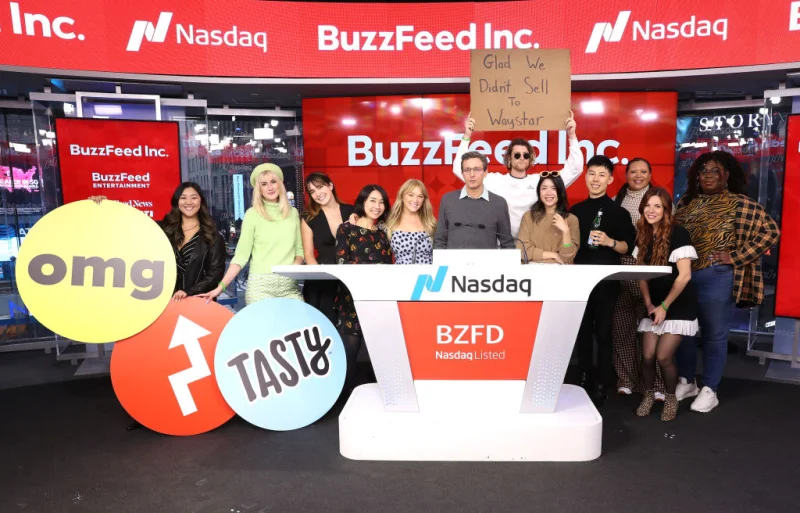
Byron Allen will pay $120 million for a controlling stake in BuzzFeed and has installed himself as chairman and chief executive, setting up a sharp remaking of the once-hot digital publisher. He says he wants to turn BuzzFeed into a free streaming service.
The deal, announced last week, gives Allen control of a company that went public in late 2021 at a valuation of more than $1.5 billion and was once worth $1.7 billion as a private company. The purchase price makes the entire operation look small by comparison: Allen is paying roughly 7% of BuzzFeed's peak figure, and most of the deal is wrapped in a five-year promissory note. The cash portion is only $20 million.
Jonah Peretti, the co-founder who built BuzzFeed in 2006 as a viral-content laboratory, has been rebranded as president of BuzzFeed AI. BuzzFeed first made its name with the listicle, then tried to evolve into something bigger. In 2012, Peretti hired Ben Smith from Politico to build a news division, a move that signaled the company wanted to be more than a factory for shareable lists and quizzes.
Allen's move lands at a moment when digital media is once again being judged by what it can actually own, not just what it can reach. BuzzFeed was once a benchmark for venture funding in digital media, and the story now folding around it is the same one that has hit Vox Media and Vice Media: money poured into new distribution platforms, but the returns never matched the ambition.
Vice is the clearest warning. It began in Montreal in 1994 as a free magazine founded by Suroosh Alvi, Shane Smith and Gavin McInnes, later got an HBO deal in 2013, then filed for bankruptcy in May 2023 and stopped publishing on Vice.com by February 2024. That collapse gives Allen's wager on BuzzFeed a harder edge. He is not buying a growth story. He is buying a brand that still has recognition, a smaller price tag than its history suggests, and a platform he believes can be repurposed.
That is why the structure of the transaction matters as much as the headline number. Allen is not putting down a conventional cash bid for a thriving media company. He is taking control with a mostly paper-backed deal and betting that BuzzFeed can be turned into a free streaming service under his leadership. The question now is not whether the old BuzzFeed is gone. It is whether Allen can make the new one matter to an audience that has already watched plenty of digital-media promises come and go.
