


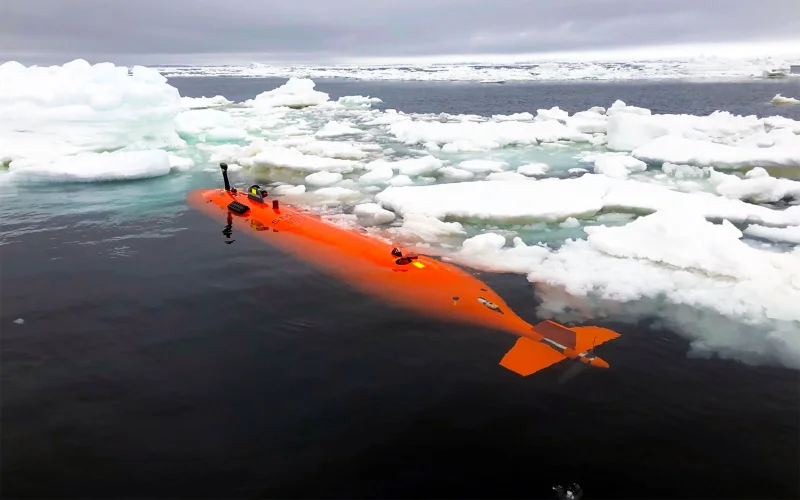
A submarine robot emerged from beneath the ice shelves of eastern Antarctica after eight months without communication, surfacing with data gathered in one of the most inaccessible places on Earth. The autonomous vehicle, part of the international Argo program, had been trapped under the ice sheets of Denman and Shackleton and kept measuring the hidden ocean all the while.
The device had spent more than two and a half years making submarine profiles in the eastern sector of Antarctica before it vanished from contact under the ice. Even after it lost the ability to surface and send satellite information, it continued to work on its own, recording measurements every five days from the seabed to the base of the ice shelves.
That persistence produced a rare haul of oceanographic records: temperature, salinity, pressure, oxygen, pH and nitrates. Researchers from the CSIRO and the Australian Antarctic Program Partnership later analyzed the data and used it to publish new findings on how stable the ice shelves may be and how much they could add to sea levels if they weaken.
The route itself was extraordinary. The robot generated the first complete transect ever obtained under an eastern Antarctic glacial structure, and scientists had to rebuild its path indirectly after the vehicle stopped communicating. Each impact against the icy base registered the ice depth, and those readings were then matched with satellite images to reconstruct where the machine had traveled.
The contrast between the two ice shelves was sharp. Shackleton showed signs of stability because it does not receive sufficiently warm currents to speed melting from below, while Denman showed warm water beneath its structure. Scientists said that even small changes in the warm layer under Denman could sharply increase basal ice melt, and they found that the heat transfer happens in a thin layer of just ten meters.
That detail matters well beyond a single robot’s recovery. The measurements help improve models used to project the future of ice shelves and estimate the impact of climate change, especially in areas that are extremely difficult to study with traditional expeditions. The findings also help explain how ocean currents alter the thermal balance of Antarctica, which is now part of the region’s wider stability problem.
The robot’s return does not close the story so much as sharpen it. Denman appears more exposed to warming from below, while Shackleton looks less immediately vulnerable, and the data now gives scientists a firmer way to test how quickly those differences could shape Antarctica’s future.
