


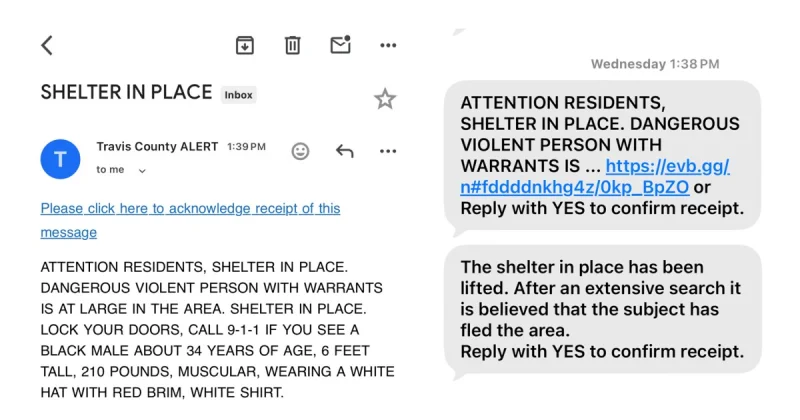
A shelter in place alert sent Wednesday to 51,789 people in South Austin sent office workers, commuters and neighborhood residents scrambling to figure out whether the warning was real. Austin police later confirmed the alert was genuine, but only after some people had already questioned whether it was a phishing attempt.
Chris Bataska got the message while he was at his office on Barton Springs Road and said his first instinct was to treat it like a possible scam. “We’ve had a lot of phishing attempts at the company so my first thought was to email it to IT because it looked like a different link than normal,” he said. “It just created some skepticism.”
John Stolz, who also received the alert, said he was “slightly confused and a little caught off guard.” He said the message “seemed really spammy,” and added that it would have been better if it had been clearer about who it was coming from and which neighborhoods were affected.
The alert covered a one-mile radius around the intersection of Willow Springs Road and Industrial Boulevard and warned about a dangerous and violent person with outstanding warrants who was at large. Austin police described the suspect as a muscular Black man in his mid-30s wearing a white shirt and a white hat with a red brim, and said he was near the St. Elmo neighborhood. Officers told the public to stay inside, lock their doors and call 911 if they saw him.
About 30 minutes after the alert was sent, the Austin Police Department confirmed on X that it was real. Roughly 10 minutes after the message went out, police lifted the shelter in place order and said that after an extensive search it believed the subject had fled the area. The FBI later said the suspect is now in custody.
The episode put a spotlight on how emergency alerts land in a city where residents are used to getting official warnings by phone, but not always in the same format. APD said it had only minor involvement in the incident while assisting the Texas Department of Public Safety and the FBI, but its message reached tens of thousands of people before the situation was resolved.
For the people who got it, the confusion was immediate and personal. The alert was meant to keep them inside while officers searched for a dangerous suspect. Instead, for several minutes, it also forced them to decide whether the warning itself could be trusted.
