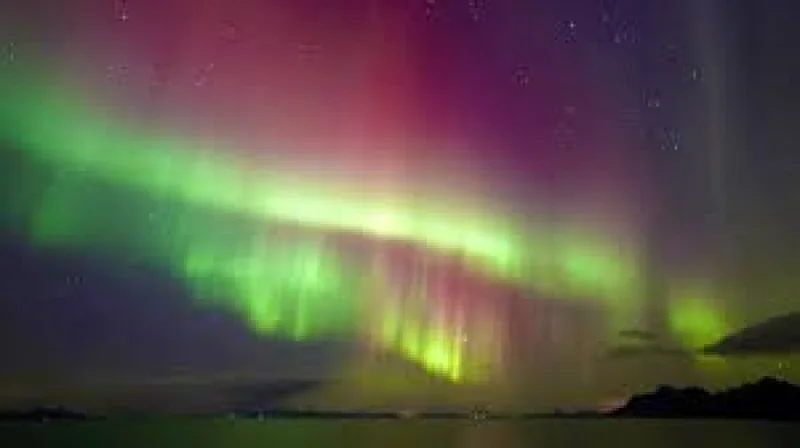
A geomagnetic storm watch remains in effect for parts of North America after weekend solar activity raised the chance of northern lights sightings across Canada, Alaska and the northern tier of the United States, with federal space-weather forecasters tracking a glancing coronal mass ejection expected to influence Earth’s magnetic field on Monday.
Aurora Chances Continue After A Weekend Storm
The aurora borealis became a focus for skywatchers over the weekend after geomagnetic activity reached G2, or moderate, levels on Friday, May 15, and G1, or minor, levels at points afterward. The strongest weekend alert suggested aurora could be visible as far south as a line from New York to Wisconsin to Washington state, although actual visibility depended heavily on cloud cover, darkness and the timing of magnetic activity.
By Sunday night and into Monday, May 18, the forecast had shifted toward a more limited but still notable event. A G1 geomagnetic storm watch was issued for Monday and Tuesday, keeping the best viewing odds in higher-latitude regions. Under a G1 storm, aurora may be visible in Canada, Alaska and parts of the northern United States, including areas such as northern Michigan and Maine.
The forecast does not guarantee a visible display. Aurora events can strengthen or fade quickly when solar wind reaches Earth, and the most vivid sightings often depend on short-lived changes in the direction of the interplanetary magnetic field.
Solar Flare And Coronal Mass Ejection Drive The Forecast
The current northern lights forecast is tied to a combination of fast solar wind from a coronal hole and a coronal mass ejection launched after solar flare activity on Saturday, May 16. A complex eruption from an active region on the sun produced M-class flares and sent solar material into space.
Early modeling indicated that the bulk of the ejected material would pass north of Earth, but a glancing blow remained possible around mid-Monday. That is the key reason forecasters kept G1 storming in the outlook for May 18, with a chance of stronger G2 conditions if the incoming solar wind connects more efficiently with Earth’s magnetosphere.
A coronal mass ejection is different from a solar flare. A flare is a burst of radiation from the sun, while a CME is a large cloud of magnetized plasma. When a CME reaches Earth, it can disturb the planet’s magnetic field and push auroral activity farther from the poles.
Where Northern Lights Could Be Visible
The best odds remain in high-latitude areas with clear skies and dark northern horizons. In North America, that generally means Alaska, much of Canada and northern parts of the contiguous United States. During stronger bursts, viewers farther south may see a faint glow near the horizon rather than bright overhead curtains.
For Monday night, the most realistic U.S. viewing zone is the northern tier, especially rural areas away from city lights. Potential viewing areas include parts of Washington, Idaho, Montana, North Dakota, Minnesota, Wisconsin, Michigan, northern New England and upstate New York if storm levels briefly strengthen.

Moonlight will not be the main obstacle during this period, but weather and light pollution remain major limiting factors. A clear sky away from streetlights can make the difference between seeing a faint greenish arc and seeing nothing at all.
What A G1 Geomagnetic Storm Means
A G1 geomagnetic storm is the lowest level on the five-step geomagnetic storm scale. It is usually not dangerous to the public, but it can create minor effects for some technology systems and increase aurora chances at high latitudes.
Possible impacts include weak power-grid fluctuations, minor satellite operation effects and high-latitude aurora visibility. The weekend’s brief G2 conditions carried somewhat broader potential effects, including possible high-latitude radio disruptions and increased drag on low-Earth-orbit satellites.
For most people, the main practical significance is the skywatching opportunity. A G1 storm often produces displays best seen from far-northern areas, while a G2 storm can occasionally extend visibility into more populated northern U.S. regions.
Best Time To Watch The Aurora
The best viewing window is generally late evening through the pre-dawn hours, when skies are darkest. For the Monday night forecast, viewers should start checking the northern sky after full darkness and continue watching around local midnight if conditions are clear.
Aurora activity can arrive in waves. A sky that looks quiet at 10 p.m. may become active later, while a predicted surge can also arrive earlier than expected or weaken before nightfall in a given location. Real-time aurora maps and local cloud forecasts are especially useful because geomagnetic conditions can change within minutes.
Phone cameras may detect faint aurora before the eye does. A steady long-exposure image aimed north can reveal green or reddish light that is difficult to see unaided, particularly during lower-end storms.
Solar Activity Keeps Aurora Watchers Alert
The latest forecast comes as the sun remains active near the peak phase of its 11-year cycle. That does not mean every solar flare will produce northern lights, but it increases the likelihood of recurring eruptions, coronal holes and geomagnetic disturbances.
For North America, the immediate watch centers on Monday, May 18, and Tuesday, May 19. The most likely outcome is a modest high-latitude aurora event, but a stronger display cannot be ruled out if the glancing CME delivers a favorable magnetic orientation.
Skywatchers should treat the forecast as a live situation rather than a fixed schedule. The weekend already showed how quickly storm levels can shift, and the next meaningful change will depend on how the incoming solar wind interacts with Earth’s magnetic field after sunset.