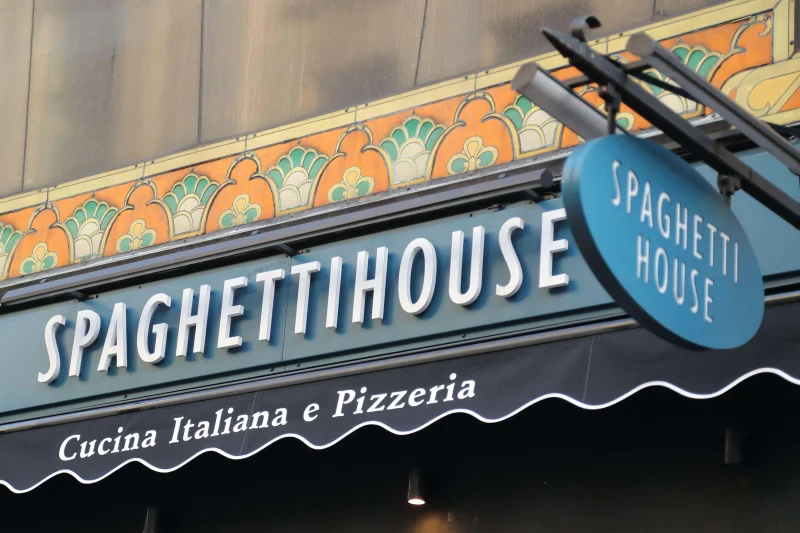
Spaghetti House has closed all of its remaining restaurants after 70 years in business, ending the run of one of London’s best-known family-owned Italian dining brands and leaving 101 employees redundant. The collapse follows the administration of Lavval Restaurants Limited, the company behind the chain, after years of rising costs, weaker consumer spending and difficult trading conditions across the hospitality sector.
A London Dining Name Comes To An End
The shutdown brings a sudden finish to a brand that began in 1955, when Simone Lavarini and Lorenzo Fraquelli opened the first Spaghetti House on Goodge Street in Fitzrovia. Over the decades, the business became a familiar part of central London’s casual dining scene, serving pasta, pizza and Italian dishes to tourists, office workers and regular local customers.
The final closures affect five central London locations: Marble Arch, Carnaby Street, Oxford Street, Kensington High Street and Cranbourn Street. Other sites, including Mayfair, Goodge Street and Fitzrovia, had already closed in recent months as the business tried to adjust to weaker conditions.
Administrators were appointed on May 6, and the company has now ceased trading. Former employees are expected to be guided through claims related to redundancy and other employment entitlements as the wind-down process continues.
Why The Business Collapsed
The company’s leadership blamed the closure on a combination of rising costs and reduced customer demand. Hospitality businesses across the U.K. have been under pressure from higher wages, energy bills, rent, food costs and tax burdens, while customers have become more cautious with discretionary spending.
For Spaghetti House, those pressures were especially difficult because many of its restaurants operated in central London, where fixed costs are high and footfall patterns changed significantly after the pandemic. Tourist traffic has recovered in parts of the capital, but city-centre restaurants still face an uneven mix of office attendance, inflation-sensitive diners and increased competition.
The company also pointed to wider instability, Brexit-related costs and government budget measures as factors that added strain. The result was a business that remained culturally recognizable but could no longer sustain its operating base.
The Human Cost Of The Shutdown
The immediate impact is being felt by the 101 employees who have lost their jobs. For hospitality workers, sudden administration can be especially disruptive because many roles are hourly, site-specific and tied to local commuting patterns.
The closure also affects suppliers, landlords and surrounding businesses that benefited from a long-standing restaurant presence in high-traffic London areas. A chain with decades of brand recognition can anchor nearby customer activity, particularly in tourist districts and shopping streets.

Spaghetti House’s farewell message thanked customers, partners and staff members past and present. The tone reflected the emotional weight of a family business closing after several generations, rather than a routine corporate restructuring.
A Brand Tied To London History
Spaghetti House was more than a collection of restaurants. It was part of London’s postwar dining evolution, when Italian food moved from specialist communities into the mainstream of British eating out. Its family-run identity helped distinguish it from later casual dining groups built around private equity expansion and standardized national rollouts.
The chain also entered British public memory in 1975, when its Knightsbridge branch became the scene of a hostage crisis after a failed robbery. Staff were held for several days before the ordeal ended without loss of life. The incident became one of the most widely remembered moments in the company’s history, though the brand endured and continued trading for decades afterward.
That longevity is part of why the closure has drawn attention. Many restaurant failures involve young concepts or overextended expansion plans. Spaghetti House was different: it was a mature, family-linked London institution that had survived recessions, changing tastes and intense competition before the latest pressures proved too much.
What It Says About Hospitality Pressures
The collapse highlights a wider reset in the restaurant industry. Established brands are no longer protected by name recognition alone, especially when rent, staffing and energy costs rise faster than sales. Casual dining operators must now balance value pricing with margin protection, a difficult equation when customers are watching household budgets closely.
London restaurants face a particularly sharp version of that challenge. Premium locations can deliver strong visibility, but they also carry high overheads. When sales soften, those costs leave little room for error. A business built for consistent footfall can become vulnerable when office workers visit less often or tourists spend more selectively.
The Spaghetti House closure follows a broader pattern of restaurant chains trimming locations, entering administration or rethinking their property estates. Operators that once relied on expansion are now more likely to close weaker sites, renegotiate leases or focus on smaller formats.
What Happens Next
Administrators will oversee the winding down of Lavval Restaurants Limited, including asset sales, creditor reporting and support for former employees making claims. There is no confirmed plan for a rescue of the Spaghetti House brand or a reopening of its former sites.
The closure leaves a gap in London’s Italian dining landscape and marks the end of a name that served generations of customers. It also sends a clear warning to the wider sector: even long-established restaurant brands can struggle when high costs meet cautious spending and city-centre trading fails to recover strongly enough.