


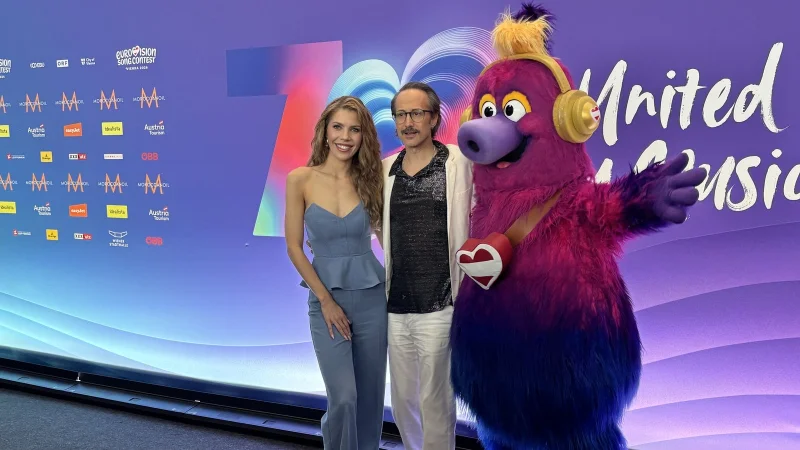
Victoria Swarovski and Michael Ostrowski are set to step into the spotlight at the 70th Eurovision Song Contest in Vienna, after ORF used the first semifinal on Tuesday evening to unveil a five-minute segment built around the idea that Austria and Australia are still often confused. The piece, titled Opposites, played the joke straight, with people in kangaroo costumes appearing on stage.
The segment was more than a gag. It was a first look at how ORF plans to frame the hosts' role in a contest that has a long memory for presenters who become cult figures. In 2016, Petra Mede and Måns Zelmerlöw delivered Love, Love, Peace, Peace, and last year in Basel, Mede was brought back on stage as a guest. Vienna is now trying to find its own version of that kind of instant Eurovision recognition, with Swarovski and Ostrowski expected to follow in the footsteps of those iconic hosts.

Behind the polished tone, the show is being shaped by a small but clearly defined team. ORF program director Stefanie Groiss-Horowitz is responsible for the basic direction of the ESC in the Wiener Stadthalle, show chief Mischa Zickler helps develop the content, and Gregor Barcal writes the moderation script, which he also does for other ORF productions such as Dancing Stars. Swarovski, who also presents the German Let's Dance, and Ostrowski are not writing their own lines; they are working from a text produced inside the broadcaster's machine.
That matters because the Vienna contest is being presented as spontaneous while remaining heavily controlled. Ostrowski said at a press conference in the media center that he would put “Entertainer der alten Schule” on his business card, and on Wednesday he explained that the script is only a proposal. Drawing on his theater background, he said the text changes on stage and that decisions are made together, adding that a joke that did not work in the first rehearsals was simply dropped. The script is read and rehearsed for weeks, but it can still be adjusted during rehearsal, which is exactly how the ESC likes to sell itself: loose at the edges, tightly managed underneath.
Ostrowski is also being cast as the Austrian touch in the pair, while Swarovski brings a familiar television presence from beyond Austria. The balance suggests ORF wants the hosts to feel local enough for home viewers and polished enough for the continent. The question now is not whether the script exists, but whether the pair can make it sound like it does not. If Vienna gets that right, the hosts may become part of the contest's memory; if it does not, the machinery behind the show will be harder to ignore than the jokes on stage.
