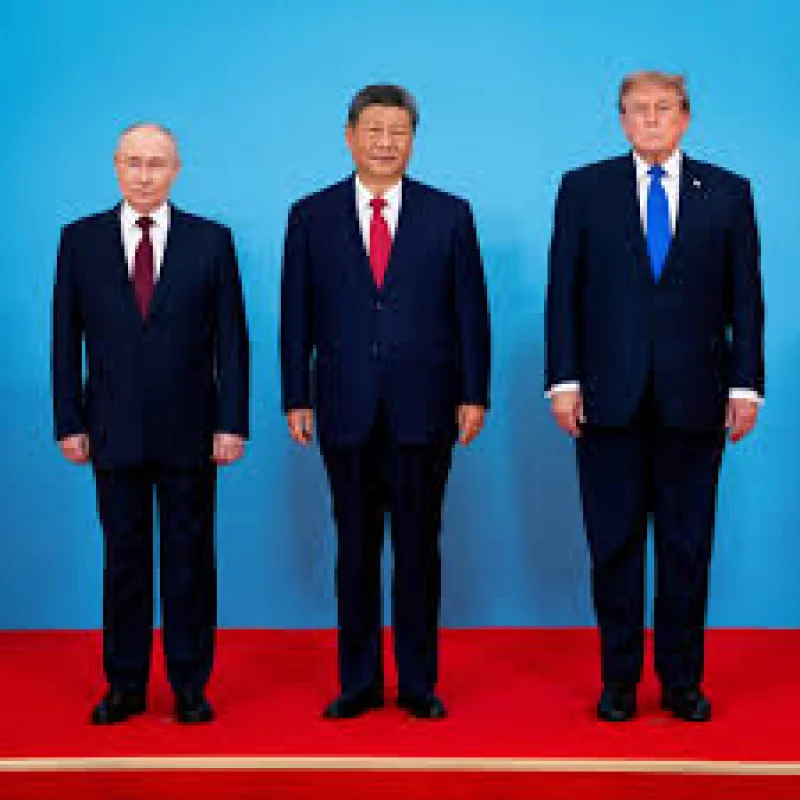
Donald Trump emerged from a 70-minute closed-door summit in Shenzhen with Xi Jinping and Vladimir Putin carrying a four-point document called the Declaration Toward Peace, the first time the leaders of the US, China and Russia have sat down together in a trilateral meeting. The official paper offered no mention of the wars in Iran or Ukraine, even as Trump pressed both men on those conflicts in separate talks later the same day.
The scene began with Xi greeting Trump personally on the tarmac as Air Force One landed for the Apec summit. An honour guard stood at attention, crowds waved miniature US and Chinese flags, schoolchildren shook pompoms and Xi drew Trump into a warm embrace before the leaders sat down at Kylin Villa in Shenzhen. Trump called the day “a big win for us” and added, “It’s a big win for China too.”
That praise was the point of the trip for Trump, who was traveling through Asia this week and used the moment to cast himself as the man who could get along with both Xi and Putin. He asked about Putin, “Who is he?” then answered himself: “He’s my friend.” He told Xi, “You’re my friend, and we have a very special relationship,” and later said, “We get along.” He also told News that the two had agreed artificial intelligence needed some form of safety, another sign that the summit was meant to project cooperation well beyond the formal declaration.

The substance, however, was thinner than the stagecraft. Trump’s one-on-one with Putin touched on Ukraine but produced no immediate commitments, coming after he had recently rejected new sanctions on Russia. In his bilateral meeting with Xi, Trump raised the US-led war in Iran and stressed a shared interest in fully reopening the Strait of Hormuz and stopping Iran from acquiring nuclear weapons. Xi, meanwhile, focused on US-China trade stability and repeated China’s sovereign position on Taiwan, treating it as an unalterable domestic issue.
The friction around the summit was impossible to miss. Trump celebrated the image as proof of strength, while critics saw a tableau of deference that made the US look smaller, not larger. Steve Schmidt called it “the image of the grotesque large round table with a war criminal dictator, a stable dictator and an irrational, delusional wannabe dictator,” and said it was “an image of deep shame and weakness for the United States,” as well as “a repudiation of American values, American honour, common sense and the national security interests of the country, and a betrayal of America’s allies all across the world.”
What remains is the gap between the ceremony and the deal. The leaders of the world’s three biggest nuclear powers left Shenzhen with a declaration that fit on four points, but not with the hard commitments that would have answered what the summit was really for. For now, Trump has a photo, a phrase and a handshaking tour through Asia. The missing piece is whether any of it changes the wars or the power balance that made the meeting matter in the first place.