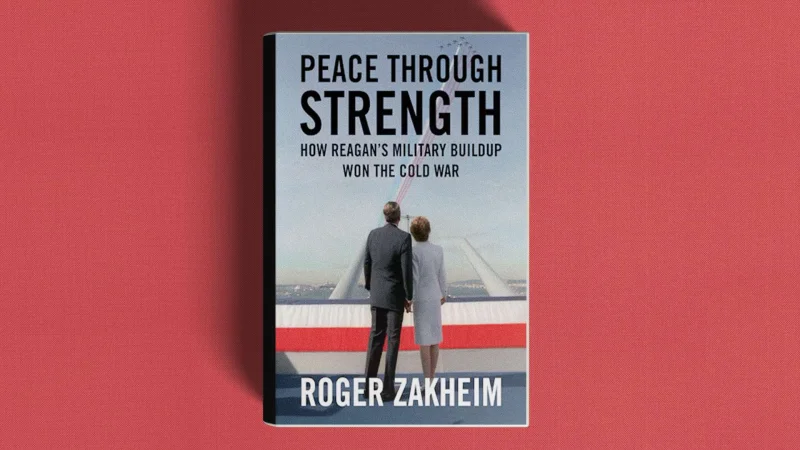
Roger Zakheim's new book argues that Ronald Reagan's military buildup helped bring down the Soviet Union. But a review of Peace Through Strength: How Reagan's Military Buildup Won the Cold War says that case goes too far, especially when it treats Reagan's hard line as the decisive force behind the end of the Cold War.
Zakheim, who directs the Ronald Reagan Institute, says Reagan's tougher foreign policy overawed the Soviet Union and helped produce less confrontational leadership in the Kremlin under Mikhail Gorbachev. He also argues that the American victory in the Cold War should serve as a model for U.S. leadership today. That claim matters now because it feeds a larger argument inside the GOP about whether military strength should still guide U.S. policy at home and abroad.

The review gives Zakheim credit for a sharp account of the ideological fight inside the Reagan administration, where David Stockman pushed budget restraint and a smaller federal government while Caspar Weinberger put military expansion first. It says Weinberger's close relationship with Reagan helped the hawkish faction win. Zakheim himself concedes part of Stockman's complaint, writing that “Stockman was right” to be uneasy and that, for Reagan, funding the buildup was “a matter of principle” and “a priority with no equal.”
That is where the book's argument runs into its hardest limit. Zakheim presents military power as a major cause of the Soviet Union's decline, but the review says the fading of the Cold War in the late 1980s was not caused entirely by that buildup. It points instead to Mikhail Gorbachev's arrival in Moscow with a relatively youthful policy team and to the broader shift in Soviet politics that Reagan did not control. On that reading, the buildup mattered, but it was only one part of a collapse that also depended on reform inside the Soviet system.
The review also sharpens the personal cost of the budget fight inside the Reagan team. Zakheim writes that Stockman said the struggle was the turning point where he “ceased to believe that the Reagan Revolution was possible.” That line captures why the argument still matters nearly 50 years later: the same split between restraint and military expansion still defines much of the GOP's foreign-policy instinct. Zakheim's book makes the hawkish case with force, but the review's bottom line is narrower and harder to escape — Reagan's buildup helped, yet it did not win the Cold War by itself.