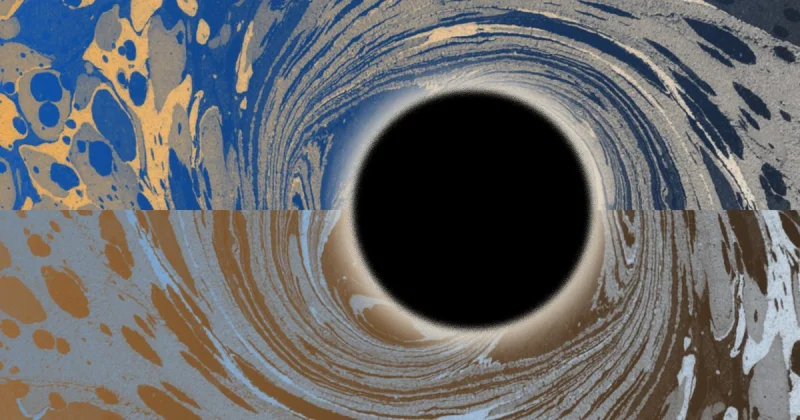
Anthropic says Claude Fable 5.2 has done what physicists had left unfinished for years: it solved two open problems in black hole physics and showed that the change from particle gas to black hole is abrupt. The result links a long-running calculation from 2003 to a broader picture of how black holes behave at the edge of quantum gravity.
That is why people are searching what does Anthropic do now. The company is not just presenting a chatbot answer here. It is pointing to a model that worked through a hard physics problem, checked its math against known results, and finished a calculation that had been too complex for people to complete. Claude did it by running a small research group of copies of itself.
The calculation matters because Stephen Hawking and Don Page showed in 1983 that the switch is abrupt, while physicists later found in 1999 that there was a phase transition in that regime as well. In 2003, a group of physicists set out to settle the remaining question: whether that transition was abrupt or smooth. Claude has now carried that work through and, Anthropic says, reached the same answer at both ends of the problem.

The deeper issue is that black holes sit where general relativity and quantum mechanics meet, and those two theories do not fit together cleanly. Physicists use black holes as a natural testing ground for quantum gravity, and they use holographic duality to recast gravity questions as quantum questions. The second problem in Claude’s calculation used a simplified theoretical universe with two dimensions of space instead of three, which made the setup easier to study without making it simple.
That is where the friction remains. Hawking and Page’s result rested on general relativity, but the description starts to break down as the theoretical universe shrinks toward the smaller scale. Claude’s answer does not remove that mismatch; it pushes the field one step further inside it, showing that the abrupt switch appears at both extremes even in the stripped-down version of the problem.
For physicists, the significance is not just that a model finished a calculation. It is that the calculation had been left open since 2003, and the same sudden transition now shows up in both versions of the setup. The question left hanging is narrower now, but it is also sharper: if a small research group of copies of Claude Fable 5.2 can complete a calculation this difficult, what other unfinished problems in quantum gravity are suddenly within reach?