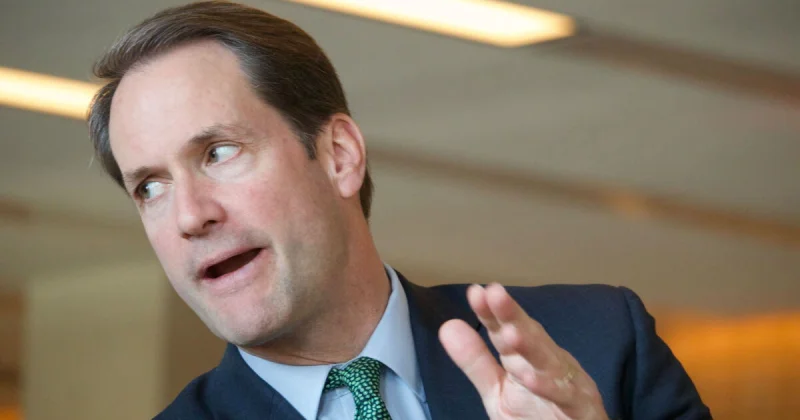
Rep. Jim Himes said earlier FAA cuts helped set off a nationwide disruption that affected millions of Americans last Friday, arguing that the problem was not a shortage of money but a collapse in priorities. In a Nov. 15, 2026 interview on Face the Nation with Margaret Brennan, the top Democrat on the House Intelligence Committee said the damage traced back to a chain of staffing decisions that left the agency weaker just as pressure on its systems grew.
Himes said Elon Musk had been “standing on a stage spinning his chainsaw around and cutting government willy-nilly,” and said part of that approach led 1,300 FAA employees to resign or retire, while 400 probationary employees were fired. He said those cuts mattered because they hit the people who keep the system working, not just the budget line. “This is not a Congress money problem,” he said. “It is a prioritization problem.”
He tied that argument to a funding debate that is still unresolved. Himes said there was $50 billion sent in the Biden administration and $12.5 billion appropriated that has not been obligated, adding that “obligated” is just a fancy Washington word for spent. He said he was not against the new $50 billion request, but that he would first ask what happened to the other $12.5 billion sitting in the bank account before putting more money in it. The request, he suggested, is not mainly about finding new cash; it is about whether the FAA can finally turn already approved money into real upgrades.

That is where the story gets harder to square. Himes says the agency’s failure is not about money, yet he also points to a large pool of funds that has not been used, leaving open the question of why those dollars were not obligated before the latest appeal for more. The answer matters because the public is being asked to trust that more funding will fix what earlier funding did not, even as staffing cuts have already produced visible disruption.
The interview then moved from aviation to a separate dispute over Alice Huang, Megaspeed, and Nvidia. Brennan said CBS had reported that U.S. intelligence agencies believe Huang, the Megaspeed CEO linked to Jensen Huang of Nvidia, was an asset of China's Ministry of State Security. Himes said Marco Rubio had circulated a memo in March or April warning that she was a spy, and he said it was now November and the President of the United States had no interest in understanding whether she was a spy. Donald Trump had said he did not know if the woman was a spy, but added that if she was, yes, and if she was not, perhaps it would be different. For Himes, the bigger point was the same as with the FAA: warnings were there, the stakes were obvious, and the response came late.
What happens next is clear enough even if the outcome is not. Congress may be asked to weigh the $50 billion request while the unanswered question over the unused $12.5 billion hangs over it, and the FAA will have to prove that new money can buy more than another round of promises. Until that happens, Himes’ sharper accusation may be the one that sticks: the system did not fail because Washington ran out of cash. It failed because the wrong people were cut and the right money was left idle.