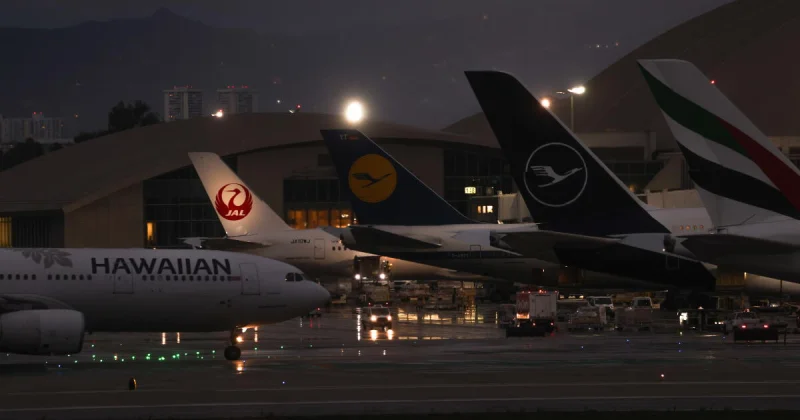
The FAA grounded all planes for more than four hours after a telecommunications failure knocked radar and communications offline during routine maintenance at a remote facility, and the fallout was still being felt Saturday. Thousands of flights were back in American airspace by morning, but airlines were warning that it would take days to untangle the mess.
That is why Dallas Love Field and airports across the United States were still on alert today: the shutdown came during one of the busiest travel stretches, with the FAA expecting 4,000 to 5,000 of the 41,000 flights scheduled in the United States on Saturday to be canceled. Friday brought more than 7,400 delays within, into or out of the United States, a scale of disruption that left passengers scrambling to change plans and airlines urging people to move trips to later dates where they could.
Transportation Secretary Sean Duffy said the trouble began when a contractor was switching telecommunication lines from 1980s-era copper wire to a fiber line at a remote FAA location. He said the new equipment started flooding other routers in the air traffic control system, with more than 1,000 connection attempts every four to five seconds, and that the flood triggered the communications breakdown. The FAA treated it as a safety issue and grounded flights while the system was brought back under control.

Duffy said around 70% of the FAA telecommunication system has already been moved to fiber, while the rest still relies on copper wire. He also thanked Donald Trump for securing a $12.5-billion investment in the Transportation Department through the 2025 Big Beautiful Bill Act and called on Congress to approve another $30 billion. On Capitol Hill, Reps. Rick Larsen and André Carson said the administration had obligated $4.3 billion but spent only $1 billion, with $8 billion unobligated and $11 billion still unspent.
The hard question is what actually failed. Officials said there was no evidence of AI or any nefarious actors, but they had not yet determined whether L3Harris Technologies or the new equipment itself was at fault. L3Harris said it was supporting the FAA’s investigation. That leaves the investigation focused on a narrower but still consequential question: whether a contractor error, a hardware problem or something else inside the modernization effort brought the system down.
Brian Bedford apologized to passengers and said no lives were harmed during the crisis. He said he was hopeful airlines would be able to resume normal schedules by close of business Sunday. For travelers who spent Friday in lines and on hold, that is the first real sign the system is recovering — but not yet the answer to what broke it in the first place.