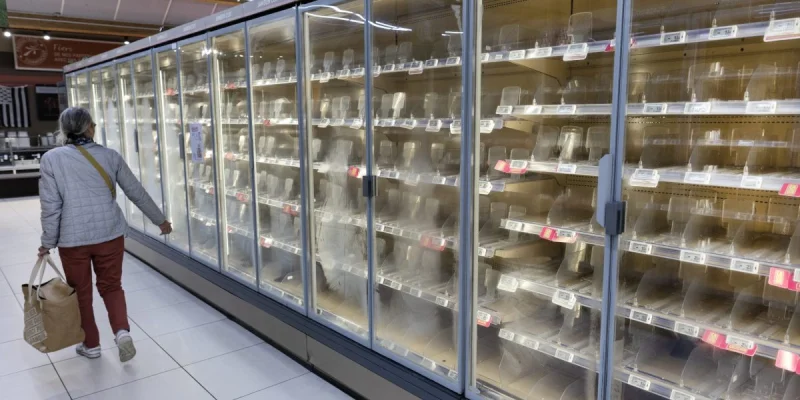
The Pentagon is investigating freezer failures at U.S. military commissaries in August as a possible cyberattack, after disruptions hit more than a half-dozen stores across the base network. The Defense Criminal Investigative Service is leading the joint probe.
The affected commissaries included Fort Irwin in California, Holloman Air Force Base in New Mexico, Naval Station Newport in Rhode Island, Little Rock Air Force Base in Arkansas, F.E. Warren Air Force Base in Wyoming, Robins Air Force Base in Georgia and Fort Huachuca in Arizona. That spread is why the search for a cause has taken on more urgency now: investigators are not treating this as an isolated freezer malfunction, but as a potential cyber incident.
The scrutiny sharpened after The Substack Signal and Silence was first to report the possibility of a hack. This week, four officials told that the Pentagon is treating the outages as a possible cyberattack, and the Pentagon confirmed that the Defense Criminal Investigative Service is leading a joint investigation into the outages. The Pentagon said, “For security reasons, we do not comment on ongoing law enforcement investigations.”

The reason the idea has traction is not hard to see. Earlier in the month, hackers targeted hundreds of French supermarkets and raised the temperature of refrigeration and freezer systems overnight to more than 122 degrees Fahrenheit. The French supermarket outages affected 80 Carrefour locations, about two-dozen Monoprix stores and 150 Intermarche stores, and the Paris prosecutor’s office called the French outages a large-scale attack.
Christopher Whyte said the timing made the U.S. outages hard to dismiss, saying, “You’d be silly not to be suspicious.” He also described refrigeration systems as an unusually direct way to inflict financial damage, saying, “Refrigerators give an attacker a weirdly direct route…to financial loss that’s, with cyber, unusually irreversible,” and, “You can’t unspoil food or other products from these freezers. It’s just Euros and dollars down the drain.”
Even so, the key fact has not changed: there is still no proof that the U.S. commissary failures were a hack, and no proof that they are connected to the French supermarket outages. Commissaries usually sell subsidized goods to people living on military bases at prices that run about 25% less than civilian grocery stores, which is why a refrigeration failure can quickly become more than an equipment problem. For now, the question investigators have to answer is whether the August outages were a cyberattack at all, and if so, whether they fit the same pattern seen in France.