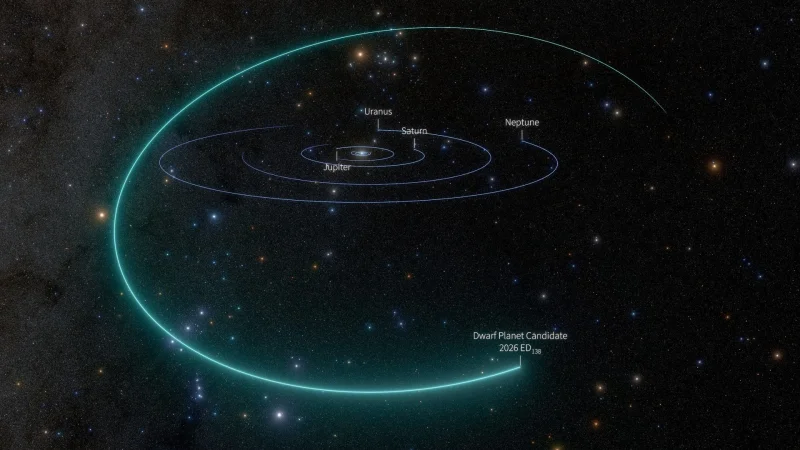
The Vera Rubin Observatory has spotted 2026 ED138, an icy object circling the sun in the frigid reaches beyond Neptune that appears to be a possible dwarf planet. Scientists say it may be large enough to join the small group of bodies that are round because their own gravity shapes them.
The finding is drawing attention now because 2026 ED138 is being discussed as a new candidate in the outer solar system, and the size estimate is what makes it stand out. Scientists say it is likely between 600 and 1500 kilometers wide, or about 373 to 972 miles across, which puts it in the range where gravity can pull a body into a sphere rather than leave it as an irregular rock.

That matters because the spherical shape is one of the key dividing lines between dwarf planets and smaller objects such as asteroids and other space rocks. Pluto sits in that category, and 2026 ED138 is being compared against the same standard: if an object has enough mass for gravity to round it off, it starts to look less like debris and more like a world in its own right.
But the new object has not been officially confirmed as a dwarf planet. The way it is being described leaves room for that judgment to change, which is why the discovery is still a possible one rather than a finished classification. In practice, that means the finding is important but not settled, and the label depends on whether further study holds up the case for a rounded body in the outer solar system.
For astronomers, that is the next question that matters. 2026 ED138 has already become a candidate worth watching, but the real significance will come if observations confirm that it belongs on the dwarf-planet list rather than among the countless smaller objects beyond Neptune. Until then, the discovery stands as a reminder that the edge of the solar system still has room for something large enough to change the catalog.