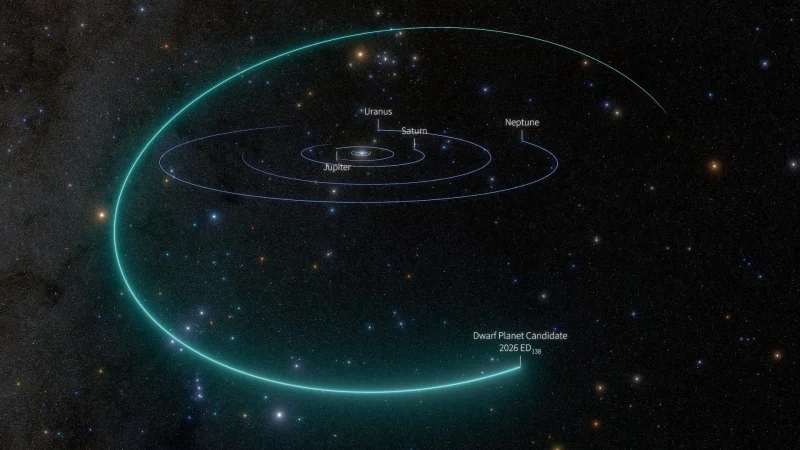
The Vera Rubin Observatory has spotted what seems to be a new dwarf planet beyond Neptune, an icy object known as 2026 ED138. Scientists say it may be one of the most intriguing distant finds yet because it appears large enough to fit the basic shape test that separates dwarf planets from smaller space rocks.
That is why the object is drawing attention now. It was spotted before publication, and its estimated width of between 600 and 1500 kilometers puts it in a range where gravity could have pulled it into a sphere. That roundness is not a formality in space. It is one of the key traits used to distinguish dwarf planets from asteroids and other small bodies.

2026 ED138 sits in the frigid reaches beyond Neptune, where icy worlds are harder to find and even harder to judge from afar. The size estimate is doing most of the work here: if the object is really broad enough, its own gravity may have shaped it into the rounded body expected of a dwarf planet. That makes it scientifically important even before any formal classification is settled.
But that is also the catch. It is being described as seeming to be a dwarf planet, not as one that has already been confirmed. The difference matters. Size alone can point in the right direction, yet a likely candidate is still not the same thing as a settled classification. For now, 2026 ED138 remains in that middle ground, compelling enough to watch closely, but not declared beyond dispute.
What happens next is the hard part: more observations will have to show whether the object really holds the rounded form its size suggests. If they do, 2026 ED138 could move from a promising find to a confirmed addition to the small club of distant worlds beyond Neptune.