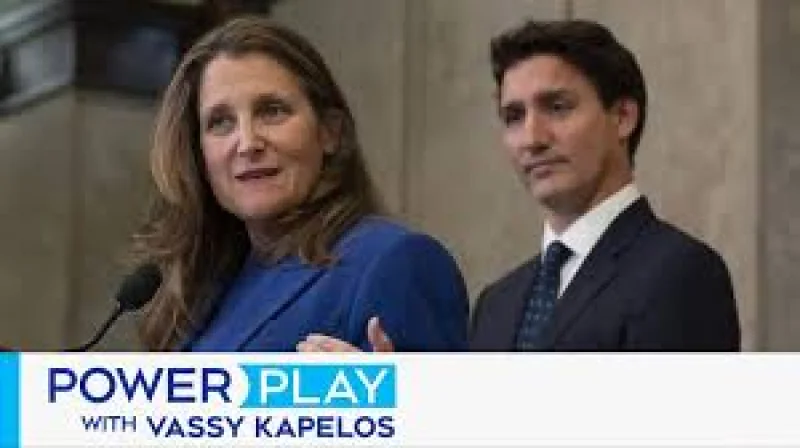
Chrystia Freeland’s new memoir lands with a political claim that is as blunt as it is rare: she says her December 2024 resignation letter was maybe the most significant in Canadian history and that it helped bring down Justin Trudeau. In the same book, she writes that she stared down Donald Trump on tariffs and that she, in her telling, took down a prime minister.
The timing is why the book is being read now. Freeland, who spent 10 years in top cabinet posts as international trade minister, foreign minister, finance minister and deputy prime minister, is recasting some of the most consequential fights of Trudeau’s era as a single story about pressure, leverage and collapse. She also describes herself as barely over five feet tall, diminutive, and profoundly, sometimes embarrassingly, earnest — a self-portrait that makes the political bite of the memoir land harder.
Freeland says the trade battle with Donald Trump began before most Canadians knew how serious it would become. She first visited Washington in February 2017, after Trump had been elected, and John McCain warned her that the new men were planning wholesale tariffs on allies, including Canada. McCain called the idea nuts, crazy, insane. Gary Cohn was blunter still: “You’re definitely going to get screwed. The only question is whether you get screwed with a kiss.”

Freeland’s account says Canada did not fold. She writes that her government succeeded in getting NAFTA replaced with USMCA and won the withdrawal of steel and aluminum tariffs. That is the backbone of her political case in the book: the fight was ugly, but the refusal to back down worked. She also writes that she had no problem giving Trudeau public praise for his backbone when she thought he deserved it, thanks ultimately to his backbone, as she puts it.
But the memoir undercuts that praise with a detail that says more than any formal critique. Freeland writes that she never called Trudeau by his first name and that, over a decade in top cabinet jobs, the two could count their one-on-one meetings on one hand. She says he was comfortable with ordinary Canadians but not at all with peers. That distance matters because her book does not describe a routine falling-out. It describes a relationship that functioned at the highest levels while barely operating as one in private.
The sharpest break came in December 2024, when Freeland resigned and later wrote that the letter she sent was maybe the most significant resignation letter in Canadian history. She says Jean Chrétien warned her over a glass of wine that if she kept propping up Trudeau, the party would be devastated in the next election. Freeland adds that a brutal defeat by Pierre Poilievre would not just be Trudeau’s fault, it would be mine too. That is the book’s most revealing line because it shifts her from witness to participant in the government’s unraveling.
There is one more wrinkle. Freeland writes that Mark Carney dropped the digital services tax on the tech sector and that a White House boast followed that Canada caved. She never mentions Joe Biden in the memoir, and that omission leaves a clean line through the book: it is built around Trudeau’s circle, Trump’s pressure and Freeland’s own choices, not around the broader U.S. political cast. For now, the book is the final word Freeland wants on those years. The unresolved question is not whether she believes she helped end Trudeau’s run. It is how much of the ending she now sees as her own doing.