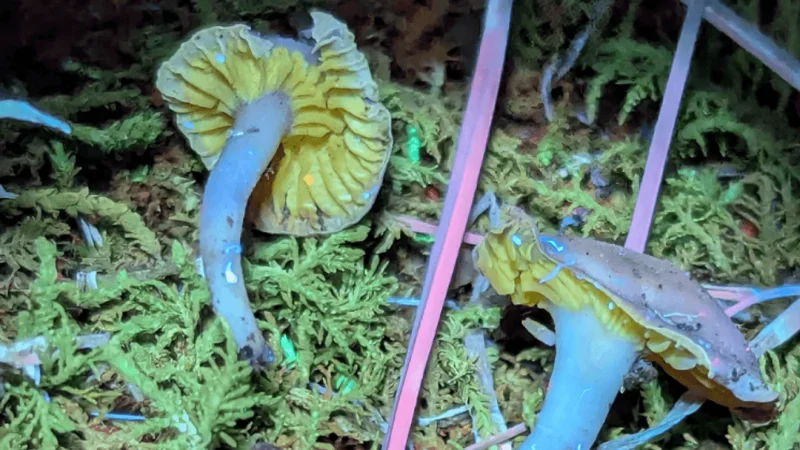
A mushroom found in West Virginia in June is now being tested to see whether it is not only a new species, but an entirely new genus. Drew Palmer, an amateur mycologist and board member with the West Virginia Mushroom Club, made the discovery and said the specimen’s DNA has already turned up a sequence never seen before.
The find is drawing attention because Palmer described the mushroom as bright purple and yellow, with chrome yellow gills, and said its colors shift under UV light. He said the same specimen can look purple and yellow, or even translucent white, before changing to brilliant blue, orange and yellow under UV light.
That is why people are asking about the West Virginia new mushroom discovery now. The testing is not just trying to pin down whether the specimen belongs to a known species. It is also checking whether it sits outside any known genus, a much bigger classification question that would place the fungus in a different branch of the family tree.

Palmer said the possibility of finding something brand new is what keeps him studying fungi. “Mushrooms are incredibly important to the ecosystem,” he said, adding that none of us would be here without them breaking down decaying organic matter and working with trees. “The trees couldn't survive without them. We couldn't survive without the trees.”
The work also goes beyond one unusual mushroom. On Friday, Palmer took a specimen with naturalist Jess Blalock at the Kanawha State Forest after staff asked him to help identify a possibly new species of zombie ant. Blalock said Ophiocordyceps is not capable of taking over humanity, even though it helped inspire stories built around that idea. Palmer described zombie ant fungi as parasites that control an ant’s body, force it to latch onto wood, grow out of it and then release spores to the next victim.
That contrast is part of the friction here: the mushroom’s DNA has already produced something no one has seen before, but the final label is still unresolved. Palmer said not to eat mushrooms that have not been properly identified and vetted with multiple sources, and he said he would rather keep making careful identifications than guess. For now, the sample from June stands as a rare find waiting on the last word from testing.