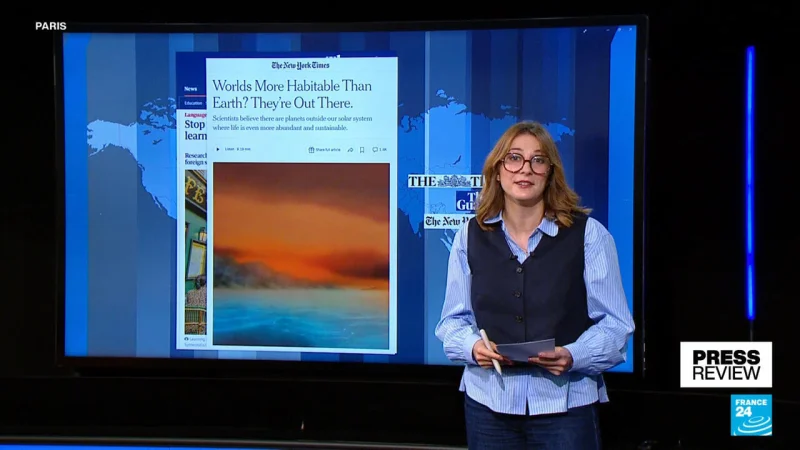
Scientists are now making a case that some worlds beyond Earth may be better places for life than our own planet. In work reported by, researchers said super-Earths orbiting K-dwarf stars could host life that is more abundant and sustainable than life on Earth.
That is why the search term superhabitable world is drawing attention now. The planets are not some nearby object waiting to be checked from a telescope roof; they are outside our solar system, which makes the claim scientifically striking and practically distant at the same time. The interest comes from the possibility that the universe may offer environments where life has more room to flourish than it does here.
The case rests on more than speculation. Scientists simulated the light coming from K-dwarf stars, which are orangey, cooler and slower-burning than the sun, and found that some leaves grow faster under that light than under our sun's light. From there, they argued that conditions on certain super-Earths may be friendlier to life than the mix of heat, weather and surface instability that defines Earth.

They went further still, describing life on those far-away planets as a kind of paradise. In that picture, the world would have better weather, a smoother surface, water flowing everywhere, and an abundance of plants and animals or aliens. That language is not a discovery in itself, but it shows how researchers are translating raw astronomy into a question people can understand: if life is out there, where would it thrive best?
The friction is obvious. These super-Earths may be better candidates for life, yet they remain beyond our solar system and outside any immediate practical reach. The result is a scientific map with a clear direction and no road for travelers. The next step is likely to be more simulation, more comparison, and a sharper search for which distant planets most closely match the conditions that might let life spread and endure.
The science item appeared in a broader France 24 press review on 14/10/2026 at 11:57, then was modified at 12:13, alongside coverage of Portugal's housing problems, an alleged assault by a humanoid robot in Germany, and language-learning research. That timing explains why the phrase superhabitable world is now surfacing: it captures a claim that is both oddly hopeful and firmly out of reach.