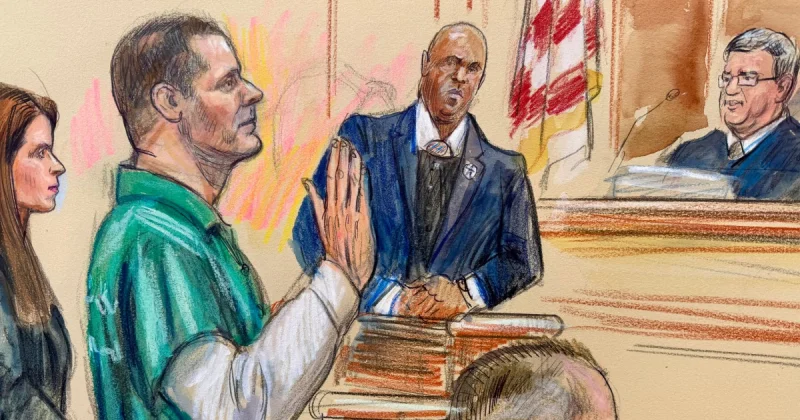
David Rush admitted in court on Tuesday that he disclosed information about a U.S. government clandestine human source to a foreign official, adding a national-security charge to a case that already centers on a vast fraud scheme and gold bars found in his home. U.S. District Judge Michael Nachmanoff approved the plea deal.
The admission came in the same proceeding in which Rush, 49, pleaded guilty to one count of wire fraud under an agreement with federal prosecutors. Justice Department officials say he siphoned off $194 million in government funds while holding a senior CIA post, and investigators later found roughly 600 pounds of gold bars stashed at his home, along with cash and luxury watches.
That is why the case has drawn attention far beyond a standard fraud prosecution. Rush had worked as a top officer at the CIA’s Directorate of Science and Technology and as a liaison to the Defense Department for sensitive military programs, giving him access to some of the agency’s most closely held work. Prosecutors say he used that position to fabricate a highly classified program that funneled tens of millions of dollars into luxury real estate in Florida, and another invented government activity to obtain the gold bars.

The plea document says the information Rush shared in late 2025 was enough to endanger the human source and the U.S. government officers working with the source. It does not identify the foreign official who received it, but the court filing makes clear the disclosure was not a stray comment; it was a transmission of details tied to a clandestine source whose safety depended on secrecy.
That secrecy sits uneasily beside the rest of the record. Before his May 19 arrest, Rush had been placed on leave and then fired. Federal agents said they recovered about 300 gold bars, about $2 million in U.S. currency and 35 luxury watches from his home, after initially giving a count of 303 bars and later revising it to 298. The shifting tally did not change the larger picture: prosecutors say the scheme was built around maximum self-enrichment at the expense of the United States.
Until Tuesday, Rush had only formally faced a charge of theft of public funds tied to falsified pay records. The new guilty plea broadens the case into one that touches both money and intelligence, and it leaves one central question hanging over the file: how a man accused of inventing programs and misleading the government for years was able to sit so close to the CIA’s most secret work for so long. He faces up to 20 years in prison when he is sentenced Jan. 28.