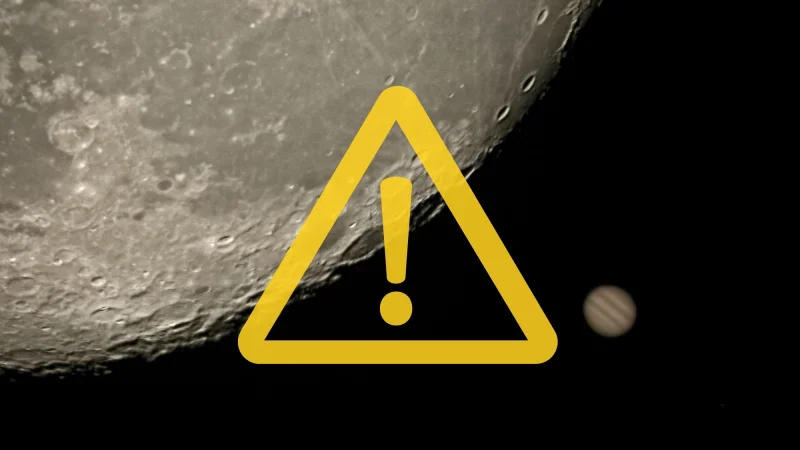
A waning crescent Moon will move directly in front of Jupiter before dawn on Oct. 6, briefly hiding the planet from view across parts of North America. For observers looking up in the dark hours before sunrise, the pairing will turn into a rare occultation, with Jupiter slipping behind the Moon’s edge and disappearing from sight.
The event is drawing attention now because it happens on Tuesday morning, when the Moon will be just 20% illuminated and a little over four days from new phase. At around 2:30 a.m. local daylight time, the crescent Moon will rise in the east-northeast, setting up the moment when Jupiter will shine near its sunlit side.
That geometry matters. A Moon that is only a sliver lit can still cover a much brighter planet cleanly, and that is exactly what will happen here. Jupiter will be hidden from view for a short time, but only where the alignment places the planet directly behind the Moon as seen from the ground.

The part that is left unstated is the part many skywatchers want most: which places in North America will actually get the show. The event is described as visible across parts of the continent, yet no finer map is given, which means the difference between seeing the occultation and missing it may come down to location within North America and the timing of the pre-dawn sky.
What is certain is the sequence. On Oct. 6, the Moon passes in front of Jupiter before dawn, and for observers in the right part of North America the giant planet will vanish behind the Moon’s darkened curve. The rest of the continent may still catch the close pairing, but the disappearance itself is the moment that will define the morning.