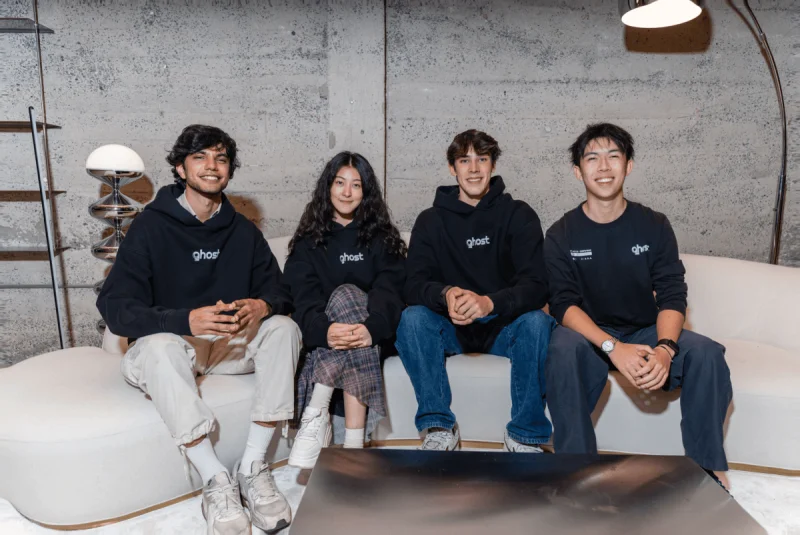
Ghost emerged from stealth on Monday with an $11 million seed round led by Andreessen Horowitz and a first product built to turn AI agents into something closer to a working machine than a chatbot. That product is Core, a $3,499 screenless computer the company says can act on a person’s behalf and keep working without constant prompting.
For Zain Javaid, 19, the launch is the result of a turn that began after ChatGPT arrived in 2022. He said he had once been headed toward quantitative work, but personal AI pulled him in a different direction because, as he put it, the feeling was unlike anything he had experienced before. Ghost is now trying to make that shift tangible for buyers who want dedicated hardware rather than another app layered onto an existing laptop.
The money behind the company suggests there is real appetite for the bet. Along with Andreessen Horowitz, Abstract, Audacious Ventures, SV Angel and Nova joined the round, while Core’s first batch of preorders opened Monday and shipping is planned for the last week of October. The unit bundles an Nvidia RTX Pro 4000 SFF Blackwell GPU into the price, and Ghost says the hardware is built around local model processing rather than a cloud-first workflow.
Core comes with Qwen-3.8-Next, Qwen-3.8-27B and Gemma-4-31B already installed, with support for other models from Hugging Face or even a user’s own trained models. Ghost says the device has its own software layer, browser and filing system, and that it can process information continuously. In Javaid’s description, it is a “brain in a box” that users reach through a phone or app, not a display sitting on the desk.
That private, local pitch is also where the product becomes more complicated. Users are told their models and personal memory stay on the device, and Javaid said personal information is encrypted so that no cloud provider or third party, including Ghost, can meaningfully access it. But voice mode still runs through the Core app rather than on the box itself, which means the experience is not fully self-contained in the way the marketing first implies.
Javaid said people can decide how much autonomy they want to grant their Core agents, though the device is designed to keep working once given a task. He also drew a line between Core and a Mac Mini configured for AI, saying Core was built from the start for agents and arrives with models already installed, while Apple’s machine is still a general-purpose computer adapted for the job. Ghost can push out over-the-air updates as new models or improvements arrive, and users can switch on auto-updates to stay on the latest generation of a given model.
The larger test now is whether a screenless personal computer for AI agents can feel indispensable rather than novel. Ghost is asking buyers to pay for hardware that makes autonomy the default, then trust the software to stay current as the models change underneath it. If Core works, it will be because the company convinces people that the easiest way to use AI is to stop treating it like software at all.