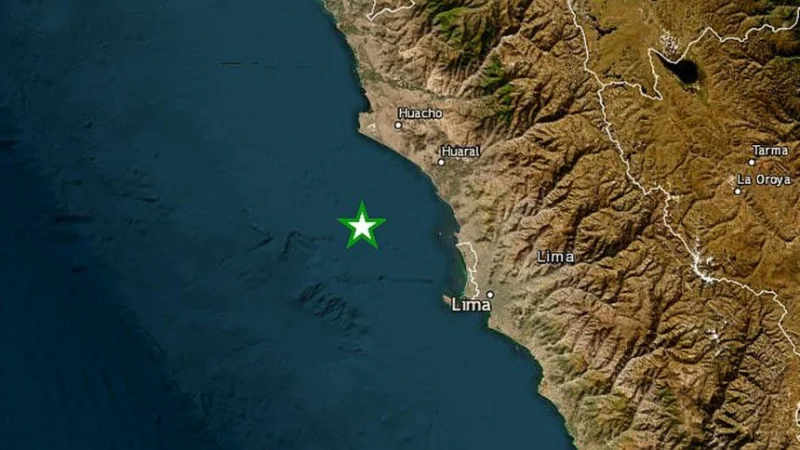
A magnitude 4.0 earthquake shook the Lima region at 11:03 a.m. today, with its epicenter in the sea 52 kilometers west of Ancón and a depth of 51 kilometers. In Ancón, the shaking reached intensity III on the Mercalli scale, according to the Instituto Geofísico del Perú.
It was the second sismo felt in Lima so far today, after a magnitude 3.5 temblor that struck before dawn with an epicenter in Mala. The pairing matters because a morning tremor in the capital region can be read as a routine jolt only until it lands in the context of a day that has already started with another one.

The IGP report, logged at 20/11/2026 11:03:00, placed the event at latitude -11.68 and longitude -77.64. That is a modest quake on paper, but César Jiménez Tintaya warned that the coast central of Perú has been storing seismic energy since the last megaterremoto in 1746, and that the major events of 1940, 1966, 1974 and 2007 have together released only about 20 % of that accumulated force.
His warning is the part that keeps this from being just another line in a seismic bulletin. Jiménez Tintaya said the region could still face a much larger earthquake, one of magnitude 8.5 to 8.8, even after the smaller shocks already recorded over the years. In that sense, the 4.0 tremor in Lima is not evidence that the pressure has been eased; it is evidence that the pressure is still there.
What remains unknown is whether the morning quake caused any damage or affected anyone beyond the brief shaking reported in Ancón. For now, the answer is not in the size of this temblor but in what came before it and what has not yet happened: a coast that keeps moving, a capital region that has already felt two quakes in one day, and a risk that specialists say has not been spent.