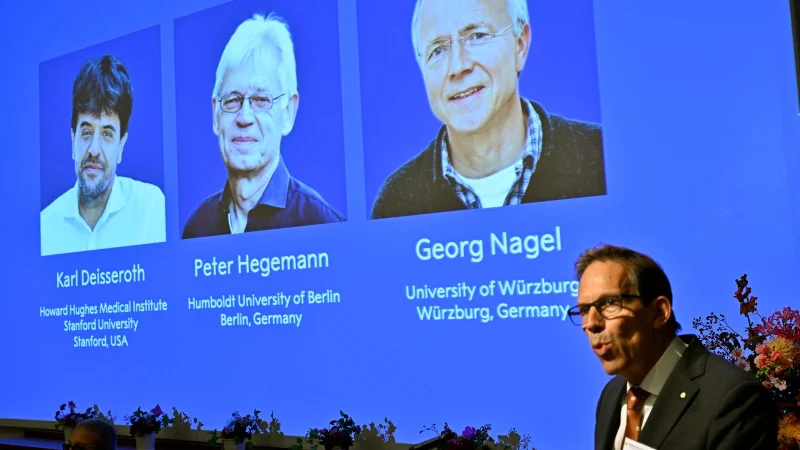
The Nobel Prize in medicine was awarded Monday to Karl Deisseroth, Peter Hegemann and Georg Nagel for research that led to optogenetics, a tool that uses light to help scientists understand how the brain works. The Nobel Assembly said the technique has opened a new era in neuroscience and is now used in laboratories around the world.
For Deisseroth, the prize recognizes work that turned light into a way to control nerve cells, not just watch them. He said people usually think of light as a way to collect information, but this is the opposite: using light to control things, make things happen and do it in a very precise way. That idea became especially powerful after he first developed tiny fibers to deliver light to cells carrying the light-sensitive gene.
The path to Monday's award began with basic research on how a single-celled green alga swims toward light. Hegemann and Nagel identified a protein that opens a channel when hit with blue light. Put that protein into other cells, and those cells become light-sensitive. Deisseroth then worked with the gene that controls the protein to create a light-controlled switch for nerve cells in the brains of living mice. His team also built the tiny fibers needed to deliver the light.

That combination is why optogenetics moved so quickly from idea to tool. It lets researchers switch on or off specific neurons and follow what happens in real time, giving them a way to study brain circuits at the same speed brain cells communicate, in milliseconds. Patrick Forcelli said the field has shifted from fixed maps of activity to functional wiring diagrams, while also pushing other methods to explore the brain's complexity.
The technique is already a mainstay in neuroscience labs, but it remains mostly a research tool rather than a direct treatment. Scientists are using optogenetics to probe regimens for autism and schizophrenia, and a form called direct optogenetics is being used to test a treatment for retinitis pigmentosa. That gap matters because the prize celebrates a method that is widely useful now, even as its medical payoff is still limited.
Jeremy Berg said the U.S. National Institutes of Health backed Deisseroth's vision with major funding in the early 2000s, long before optogenetics became standard laboratory practice. The Nobel award on Monday, in Stockholm, puts that long arc on display: a discovery that began with green algae, moved through blue light and tiny fibers, and now sits at the center of how scientists study the brain. What remains unresolved is how much of that laboratory success will become treatment.