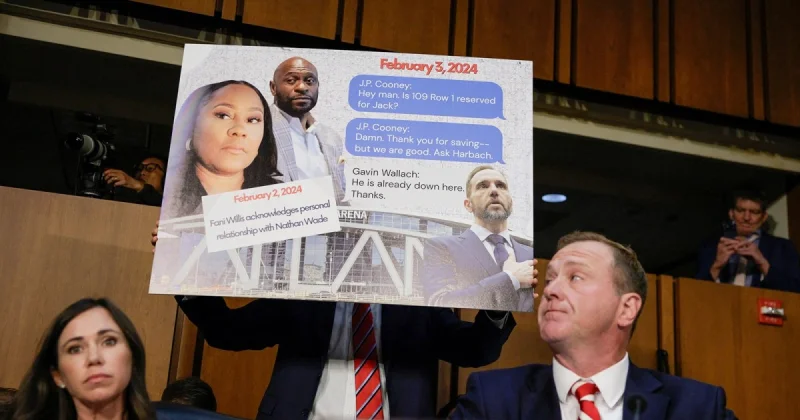
Eric Schmitt used texts from the Justice Department to suggest that Jack Smith had colluded with a Georgia state prosecutor, but the claim fell apart within minutes during a Senate Judiciary Committee hearing broadcast live on C-SPAN. The exchange turned on records Schmitt’s own staff had been told were unvetted.
The urgency came from the hearing itself. Republican staff on the Senate Judiciary Committee had received materials from the Justice Department ahead of Smith’s appearance, and Schmitt’s team had asked for anything that might connect Smith’s investigation to Fani Willis’s probe. After that request, staff gave access to the texts but warned Schmitt’s team that the records were unvetted and that it was their responsibility to verify them before relying on them.
Schmitt still used them. He said Smith had attended an Atlanta Hawks basketball game in February 2024 and suggested that visit may have been part of some kind of coordination with Willis. But the texts did not supply that leap. They were not included in Chuck Grassley’s memo to senators, and Grassley did not share them with Democratic senators before the hearing, underscoring that the material had not been treated as settled evidence even inside the GOP’s own preparation for the session.

That is where the story breaks from a simple partisan attack and becomes a sharper question about oversight on Capitol Hill. Schmitt also argued that it was not unusual for the Justice Department to turn over a limited set of nonsensitive records in a case or program under congressional review, but that explanation did not answer the bigger problem: he had presented disputed material as proof of collusion before it had been checked, and the record unravelled in public.
The episode fits a broader Republican effort to find misconduct by Smith and his staff, an effort that has produced allegations and conspiracy theories but no concrete examples of wrongdoing. It also sits beside prior claims that the records did not support, including accusations that Smith had wiretapped GOP members of Congress. Against the backdrop of Smith’s work on efforts by Trump and his allies to overturn the 2020 election, the hearing showed how quickly a charge can collapse when the evidence behind it is thinner than the argument built on top of it.
What remains is not whether the allegation was loud enough to make news. It was. The question is why Schmitt’s team treated unvetted texts as usable ammunition at all, and whether the next round of scrutiny on Smith will keep running into the same problem: aggressive claims, weak proof and a record that does not hold up when the cameras are on.