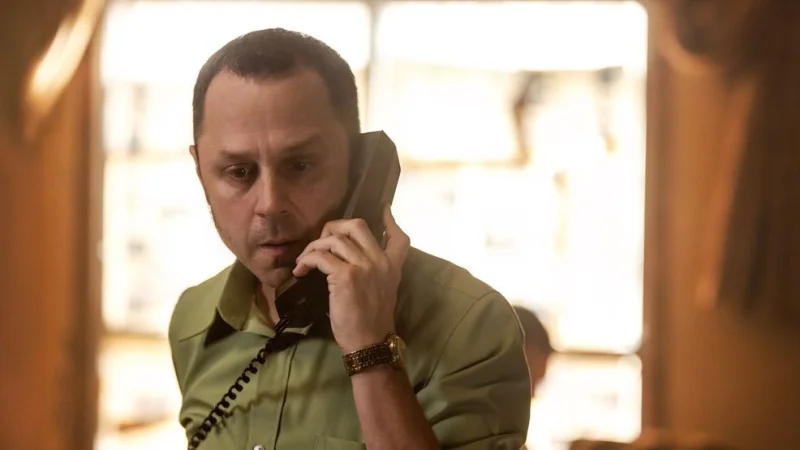
Prime Video has put John Hamm at the center of “American Hostage,” a new series that returns to the 1977 Tony Kiritsis hostage crisis and the radio voice that carried it into homes across Indianapolis. Hamm plays Fred Heckman, the broadcaster who spoke with Kiritsis as the standoff stretched on for 63 hours.
The timing is the hook. The series is releasing two episodes every Sunday, giving viewers a fresh reason to revisit a crime that once pulled attention away from everything else, including coverage of the Academy Awards. Giovanni Ribisi stars as Tony Kiritsis, with Kristoffer Polaha as Dick Hall and Mireille Enos as Heckman’s wife Barbara, turning a true story into a weekly release that arrives with its own built-in curiosity.
The real event had a strange public life. Kiritsis held Hall hostage, called into WIBC, and spent much of the crisis speaking with Fred Heckman while the story spread far beyond the city limits. At the time, the episode was treated as both terrifying and irresistible, the kind of live spectacle that drew the public in even as it unfolded around a man with a shotgun and another man trying to survive it.

That is the part the series is leaning into, and not just as drama. Ribisi said the cast kept returning to the absurdity of how the public and news corporations bought into the moment, even while a hostage situation was playing out in real time. He pointed to the fact that coverage cut away from John Wayne’s acceptance speech at the Academy Awards and to a press conference Kiritsis gave for about 45 minutes, a reminder that the crisis was consumed almost like entertainment even while it was happening.
Hanania’s job on the production side was to make the radio station look and function like the one listeners would have heard in the 1970s. She tracked down equipment from the era, and the search led to a person in Winnipeg with a garage full of radio station gear that still worked and could be connected. The result was so complete that the crew could have actually broadcast much of what Hamm’s Heckman was saying.
That kind of reconstruction matters because the series is not just replaying a crime; it is recreating a media moment that blurred the line between reporting and spectacle. Polaha described the story as a clash of two Americas, one drawn to rebellion and one to order, and that split helps explain why the case still reads as more than a local hostage crisis. It was a public performance as much as a police standoff, and the production is trying to make that uncomfortable overlap visible again.
The next question is how the weekly rollout will shape the story’s power. With two episodes arriving each Sunday, “American Hostage” is set up to keep the standoff in view long enough for viewers to sit with the part that made it so hard to ignore the first time: a real man, in real danger, turned into a national distraction.