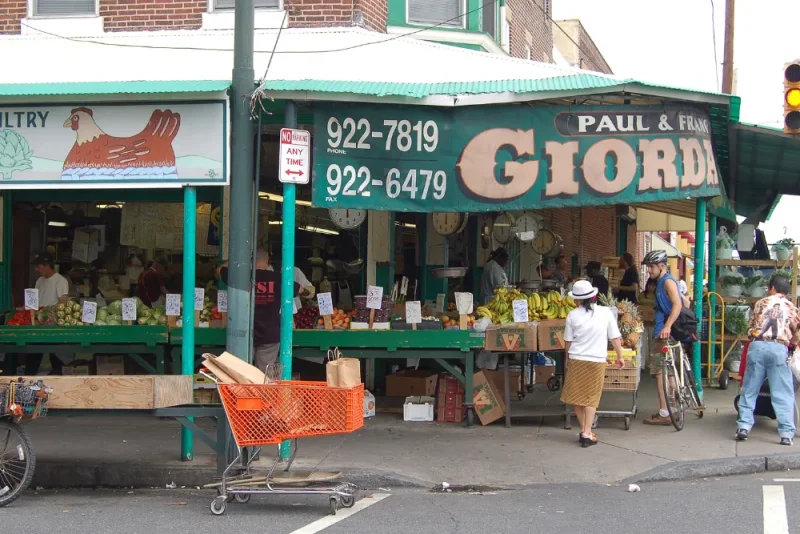
Philadelphia’s Italian Market still carries the footprint of a 19th-century business corridor, but the same narrow South 9th Street sidewalk that helped it grow now leaves pedestrians threading past merchandise, delivery carts, and uneven pavement. For people walking between Christian Street and Washington Avenue, the hazard is not abstract. It is built into the block.
That matters now because falls remain a major injury threat. In 2024, the National Safety Council said falls were the second leading cause of preventable deaths from injury, a reminder that a bad step on a crowded sidewalk can become much more than a nuisance. In a place like the Italian Market, where curbside displays, parked vehicles, and foot traffic all compete for the same space, the search for a car accident lawyer near me can easily overlap with a very different kind of claim: a premises case tied to a sidewalk fall.
The market’s shape explains why the risk lasts. It grew along South 9th Street as Italian immigrants sold produce, fish, and meat from pushcarts before moving into permanent storefronts. The ground floors filled with shops while families lived above, and the corridor was formally recognized as a business district in 1915. Its original merchants’ association even took on paving and lighting, evidence that sidewalk conditions were already part of the market’s daily life.

That older layout still defines the walk today. Rowhouse storefronts, awnings, and curbside displays crowd a corridor that has never been designed for easy movement, and ongoing redevelopment continues to reshape parts of it. Pedestrians still have to step around crates, hand trucks, and the seam where one surface gives way to another. Near Wharton Street and East Passyunk Avenue, congestion builds further as foot traffic spills into already tight corners.
The market is also broader than its name suggests. It was never exclusively Italian. Jewish merchants were part of its early history, and Korean, Vietnamese, Chinese, and Mexican businesses later joined the corridor. That mix helped sustain the district, but it also means more deliveries, more storefront activity, and more chances for a surface defect to stay hidden until someone is already on it. Crowded sidewalks, parked delivery vehicles, and displays can obscure what should have been obvious.
Philadelphia property maintenance laws require owners and occupiers to keep sidewalks, entryways, and common areas reasonably safe, including repairing sidewalks and removing snow. In practical terms, liability often turns on notice: whether the owner or occupier knew, or reasonably should have known, about a dangerous condition and failed to fix it or warn about it in time. In a corridor where hazards can shift by the hour, that question can matter as much as the condition itself.
Rand Spear The Accident Lawyer describes itself as a family-run firm with detailed knowledge of South Philadelphia’s neighborhoods, and it says it has won more than $1 billion in verdicts and settlements for injured clients throughout Pennsylvania and New Jersey. But the larger point in the Italian Market is simpler. A historic business district can be a source of daily commerce and a recurring source of injuries at the same time, and the person who misses a step there may first need a lawyer who understands why that sidewalk was unsafe in the first place.