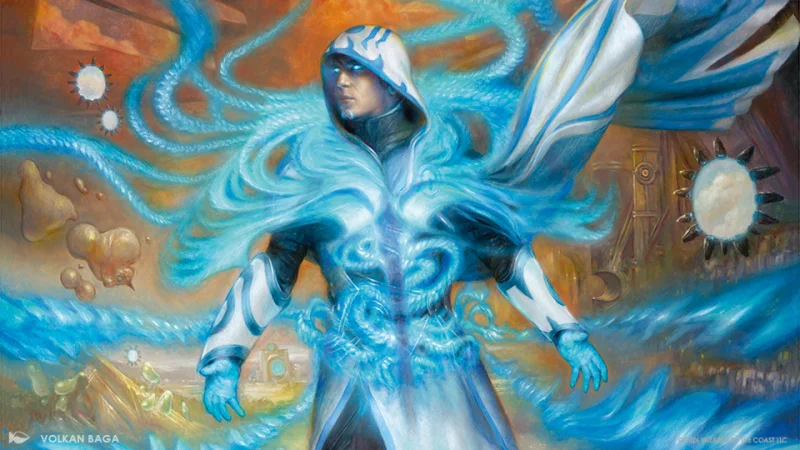
Wizards of the Coast will release Reality Fracture on Oct. 2, opening a new mainline Magic: The Gathering set built around The Echoverse and headed straight for Commander. The company also showed four cards from the set, giving players the first concrete look at how its “what if” premise will play.
That matters now because Wizards is not treating this as a side experiment. Reality Fracture is being framed as the next big turn in Magic’s story, with Jace Beleren at the center and a setting the company describes as his magnum opus: an artificial Multiverse of his own design. The pitch is simple enough to draw attention and strange enough to keep it: familiar legends, but remade, and familiar cards, but twisted into new versions.
Mark Rosewater said the idea of another what if set had been on his radar for years because players kept asking for one. “Doing another ‘what if’ set is a frequent player request, so it was something I’ve been on the lookout to do for years,” he said. Once The Echoverse came into view, he said, the answer was immediate: “Okay, we have our ‘what if’ set.”

The new mechanic is called empower Jace. Rosewater said it was inspired by amass from War of the Spark, but it works differently in a way that changes the math of a deck. Amass builds a creature token and adds counters to make it larger; empower Jace creates a planeswalker token instead. He said common cards in the set can create that planeswalker token, something Magic has not done before at common. “We’ve never made common planeswalkers, so having common cards create a planeswalker token was dipping into space we’d never previously explored,” he said.
The four revealed cards underline how far the set is willing to push the idea. Wizards says favorite legends will take on new colors, while favorite cards are turned into new versions, and Meris Mullaley described the Echoed Pairs as “a kaleidoscope of divergent paths.” Some of those pairs began as top-down ideas about how a character or plane might look in a different color; others started with mechanical hooks. The team, Mullaley said, spent time asking how legendary characters would think, behave or appear if they embodied a different mana color.
Reality Fracture did not begin as a one-plane story. Rosewater said the project was originally mapped across a whole number of planes in the Echoverse, but feedback on March of the Machine pushed the team to narrow it. The first plane considered was Mirrodin Pure, then the design shifted to Hexhaven, which Rosewater called a what if version of Strixhaven. He said Hexhaven made sense because players had just been there, and because there was a clean way to recast Strixhaven with ally-colored colleges instead of the usual enemy-colored ones. Mullaley added that Hexhaven gave newer players a setting they would recognize, with Secrets of Strixhaven having come first.
The result is a set with a clear release date, a new mechanic that changes how tokens enter play, and a story built to rewrite the familiar without losing the familiar shape. If the four cards are the first proof, the next one comes on Oct. 2, when Reality Fracture arrives and the full version of The Echoverse has to stand on its own.