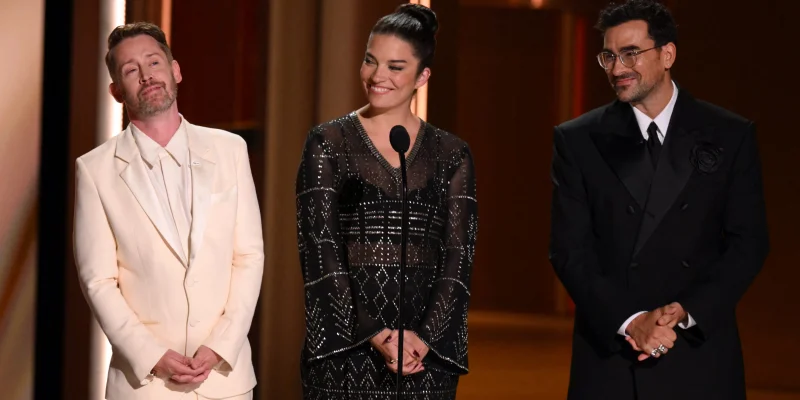
The 2026 Emmys turned its In Memoriam segment into a tribute to Catherine O’Hara, with Macaulay Culkin, Dan Levy and Annie Murphy gathering onstage to honor the actor who linked Home Alone and Schitt’s Creek. The moment was meant to remember her, but it landed with the warmth of a reunion.
That is why viewers searching for O now are finding a story about more than a memorial. O’Hara had played Kate McCallister, the mother of Culkin’s character in Home Alone, and Moira Rose on Schitt’s Creek, where Levy played David and Murphy played Alexis. Bringing the three former co-stars together at the 2026 Emmys made the tribute feel personal before it felt formal.

Murphy gave the evening its most human edge. She recalled the way O’Hara’s death had spilled into ordinary life, saying that after they lost Catherine, she was passed a note on an Air Canada flight that said, “She was so special. I hope you’re doing okay,” and that on a drive up north she was hugged by an extremely gruff-looking gas station attendant who was also grieving her loss. She added that while buying wine, she was treated to “a very lively Catherine O’Hara mashup,” describing it as a woman singing “Where’s the baby?”
Levy’s remarks framed the loss in the language of work, affection and craft. He said the greatest lesson he learned from Catherine, professionally and personally, was to always say yes — yes to her instincts, yes to a character over the age of 60 in leather miniskirts and 8-inch heels, yes to the rewrite she might email the night before, and yes to the idea that she could keep surprising an audience. He later wrote in January, after O’Hara’s passing, that she was extended family before she ever played his family, and that it was hard to imagine a world without her in it.
That is what made the Emmy segment feel unusually charged. An awards-show memorial usually moves with distance and formality, but this one leaned into affection, as if the people onstage were still speaking to a collaborator rather than eulogizing a legend. Murphy later captured that same feeling in January, writing that O’Hara’s laugh was “perpetual” and that anyone who heard it was challenged to join in, before adding, “Gosh, were we ever lucky to have her.” The unanswered detail is not who honored O’Hara — that part was clear — but how long her work will keep drawing grief, gratitude and applause into the same room.