Physicists at the University of Oxford helped confirm quantum entanglement in pairs of Z bosons produced in collisions at CERN's Large Hadron Collider, a result that pushes the effect into one of the most extreme settings yet tested. The particles vanished in a fraction of a second, but not before researchers could read out the evidence in data published in Physical Review Letters on September 11, 2026.
The finding is drawing attention now because it places entanglement in particles created at thirteen trillion electron volts, where protons were smashed together at 99.99% the speed of light. That is very different from the familiar laboratory picture Alan Barr described, where entanglement is usually associated with delicate single-photon experiments. Here, the signal came from Z bosons, massive and short-lived, produced inside the collisions rather than prepared one by one on a bench.
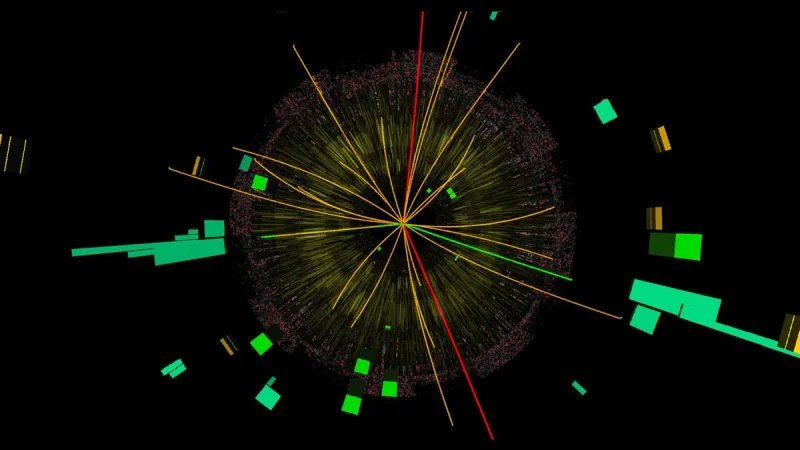
To isolate the effect, researchers reconstructed the angles of emitted electrons and muons following Z boson decay and used those decay products to infer the original bosons' spins. The same event displays also showed the ZH → μμcc process, in which Z bosons decayed into two muons and a Higgs boson decayed into two charm quarks, underscoring how much information can be squeezed from a single collision. In that framework, the entanglement signal is not being measured directly in the abstract; it is being built back up from the pattern left behind after the bosons disappear.

That is what makes the result harder to achieve than the photon studies that first made quantum entanglement famous. Single photons can be prepared and measured in controlled laboratory setups; Z bosons cannot. They are created in violent collisions, survive only briefly, and must be inferred from their decay products before the trail goes cold. The measurement therefore depends on extracting spin information from a crowded collision environment, not on watching a pair of clean particles drift apart.
Professor Daniela Bortoletto said the measurement demonstrates the scientific power of the ATLAS collaboration and the unique capabilities of CERN's Large Hadron Collider. CERN has been building toward this kind of work for years: it launched the Quantum Technology Initiative in 2020 and now works with IBM Quantum and Google Quantum AI, while also using IBM quantum computers for LHC data analysis and quantum simulation programs through Amazon Braket and the IBM Quantum Network. Those links do not explain the entanglement itself, but they show why CERN is treating quantum tools as part of its wider research program.
The broader significance is that entanglement has now been observed in one of the heaviest quantum systems ever tested at a collider, not just in light-based experiments that have long dominated the field. The collaboration, backed by over 17,000 scientists and engineers from 113 countries, has shown that quantum correlations survive in a place where matter is whipped into and out of existence almost instantly. What remains open is the next step: how far this method can be pushed, and whether the same approach can sharpen future searches for new physics in the ATLAS data.