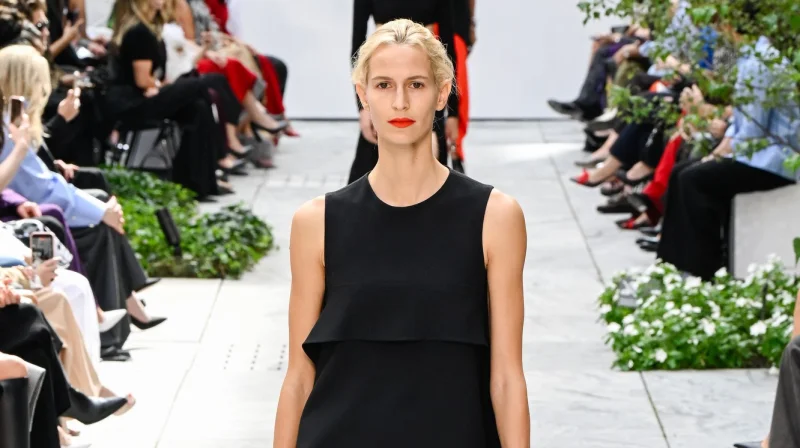
Michael Kors brought a modernist charge to the sunny courtyard of the Museum of Modern Art, staging a show that looked backward to Alexander Calder and forward through fashion’s usual runway logic. The collection leaned on shape, color and movement, but Kors also framed it as something heavier: a remembrance on the 25th anniversary of 9/11.
The search around Olivia Munn may be driving interest in the event, but the collection itself belonged to Kors and his own point of view. He had traveled with his husband to Paris this summer, where a major Calder retrospective left them, as he put it, “just in love!” at a preview before the show. That trip became the emotional engine behind a collection built on modernism’s clean lines and Calder’s playful scale.
Kors said he was “indebted” to Calder, and the clothes made the link plain without becoming literal. The first model wore glossy black disc earrings the size of potato crisps suspended from glinting stainless steel hooks. Elsewhere, an evening dress came carved with crescent-shaped edges at the shoulders in homage to Matisse’s cut-outs. A pencil skirt zigzagged with black and white stripes that nodded to Carmen Herrera, while a ribbon of banana yellow floated from the hem of a black dress with the easy confidence of Ellsworth Kelly.

He described the collection in the language of optimism, saying he loved “the boldness of modernism and the optimism of it.” That mood mattered because the show was not just an art-school exercise. Kors said it was a remembrance and a tribute to the resilience of the city, placing polished abstraction beside a day that still carries civic weight. The result was a runway with two messages at once: celebration and memory, elegance and loss.
That friction is what gave the show its edge. The clothes were airy and decorative, but the setting and date pulled them into a different register, one in which fashion was asked to carry public meaning as well as private taste. Kors did not resolve that contradiction so much as stage it, and the collection’s strongest pieces seemed to live inside it. What remains unanswered is how much of the Calder retrospective he translated directly into the clothes, and how much he used it as a springboard for a broader meditation on modernism.
The show also sat beside another fashion conversation: a separate Calvin Klein collection shaped by Georgia O’Keeffe, part of Veronica Leoni’s push away from jeans, boxer shorts and logos and toward what she called the “discipline of removal.”