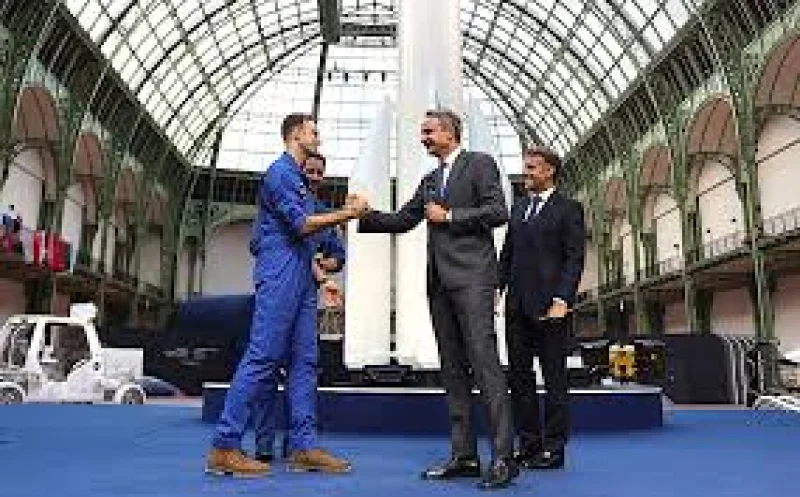
Kyriakos Mitsotakis is set to meet Emmanuel Macron at the Élysée Palace in Paris, the next stop in a fast-moving diplomatic calendar that now runs from the eastern Mediterranean to Saudi Arabia. The Greek prime minister’s trip comes after a trilateral summit with Greece, Egypt and Cyprus and before visits to Kastellorizo and, he has said, Saudi Arabia very soon.
The timing matters because Mitsotakis is trying to keep several tracks moving at once. On the same agenda sits the Great Sea Interconnector, where Meridiam has taken a majority stake and Nexans has the technical lead, even though no date has been announced for laying the cable. That project is tied to the wider political message in Athens: Greece wants energy links that reach beyond the region and into Europe, and it wants them to be seen as part of a broader strategic map rather than as a single bilateral deal.

The trilateral summit produced that map in formal language. Its joint declaration focused on the Law of the Sea in maritime zones, restraint in the use of force, a Cyprus settlement based on UN resolutions, the withdrawal of all foreign forces from Libya and an energy corridor linking Egypt, Cyprus, Greece and Europe. Abdel Fattah el-Sisi called it a model of regional cooperation, while Nikos Christodoulidis emphasized the energy outlook. But the declaration also left out one name that hangs over every one of those issues: Turkey.
That omission was not accidental. Turkey has not signed UNCLOS, keeps its casus belli policy in place, insists on a two-state solution in Cyprus and maintains a military presence in Libya. The result is a declaration built around maritime law and regional stability that avoids naming the country most directly involved in the disputes it describes. Mitsotakis made the same point in sharper language when he said stability does not mean backing down or tolerating a fait accompli.
His calendar gives that line immediate weight. According to reports, he will be in Kastellorizo from Friday to Sunday, with the 13 September festivities as the high point, before the European Council on 15 and 16 October and the second EU-Gulf Cooperation Council summit in Saudi Arabia on 24 October. He also used the Thessaloniki International Fair to say the Saudi-Turkish agreement does not change Athens’s core priority and to announce a visit to Saudi Arabia very soon, adding that foreign policy is far more complex than that. The question now is not whether Mitsotakis has a crowded schedule. It is whether he can turn that schedule into leverage across Paris, Kastellorizo and Riyadh without letting the region’s fault lines pull the agenda apart.