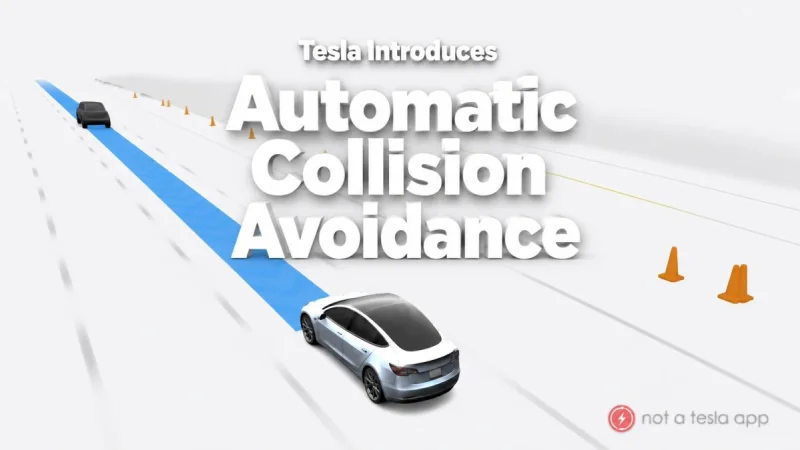
Tesla has introduced Automatic Collision Evasion, a new safety feature that can automatically engage Full Self-Driving (Supervised) during manual driving when the car detects an emergency it believes braking alone cannot avoid. In those moments, Tesla says the system can steer around an obstacle by changing lanes or moving onto the road shoulder, then brake or accelerate as needed before resuming the drive.
The company is positioning the feature as a last-resort intervention, not a routine driving aid. That matters because it expands the role of Tesla's autonomy stack from assistance to active protection on a human-driven trip, with the car briefly taking over only when the hazard is immediate and the system decides a maneuver is safer than waiting for the driver to respond.
Search interest around the Tesla Automatic Collision Evasion Feature is being driven by a simple question: what exactly does it do, and when does it step in? Tesla says the first trigger is a frontal collision scenario, where another vehicle is directly ahead, braking alone cannot prevent impact, the car is on a controlled-access highway at less than 85 mph, no pedestrians, cyclists, or other vulnerable road users are detected, the steering system is working, and the road is not wet or slippery.

A second trigger is broader. If the vehicle detects that the driver is no longer in control or paying attention to the road, or concludes that FSD was unintentionally disengaged, it can automatically assume control between 22.5 mph and 85 mph on any roadway type. In both cases, Tesla says the feature appears to work only if Full Self-Driving (Supervised) has already been purchased and enabled in Controls > Self-Driving, and that it is available only in North America for now.
That limited rollout leaves a sharp unanswered point for drivers elsewhere, including the Netherlands, where FSD is already present. Tesla has not explained how often Automatic Collision Evasion has been triggered in real-world driving, and it has not said when the feature will expand beyond North America. It also has not laid out how the system weighs a swerving move against braking alone in a split-second emergency.
The fine print is just as important as the feature itself. During an active evasive maneuver, the accelerator pedal is muted, pressing the brake slows the vehicle but does not disable FSD or the maneuver, and a driver who wants to override it must apply firm, deliberate steering force against the wheel. Once the hazard clears, the car sounds a chime and prompts the driver to take back control.
That balance is the point Tesla is trying to strike: a system meant to intervene in the seconds when a crash looks unavoidable, while still leaving the human responsible for staying alert and in control at all times. For now, Automatic Collision Evasion looks less like a new mode of driving than a narrow emergency backstop, and Tesla is not yet saying how far beyond North America it plans to take it.