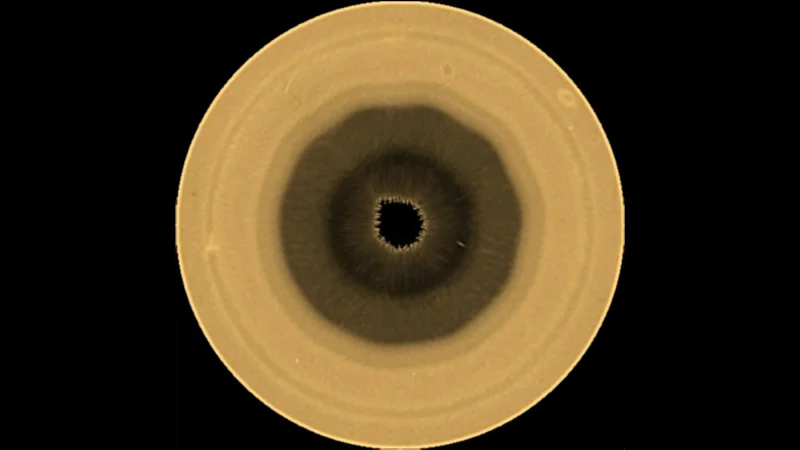
A giant 10-sided atmospheric polygon has been spotted around Saturn's south pole, and high-quality images from the Hubble Space Telescope have now confirmed it. The feature had been traced back to 2023, giving astronomers a clear timeline for a pattern that had gone unnoticed in earlier views.
Agustín Sánchez-Lavega said the discovery was a surprise, because earlier images from the Hubble Space Telescope and the Cassini spacecraft had not shown the wave. That matters because Saturn's north pole has long been known for its six-sided hexagon, first seen in Voyager images in 1980 and 1981, and the new finding suggests the planet can build polygonal waves in both polar regions.

The south-pole structure is not a mirror image of the north-pole hexagon. It sits at a less polar latitude, centered around 60 degrees south rather than near the pole itself, and it appears to be a broad atmospheric wave riding one of Saturn's powerful eastward jet streams. That jet stream races around the planet at roughly 420 kilometers per hour, while the decagon itself moves at about 10 kilometers per hour.
There was also a clue before the confirmation. Amateur astronomers saw a dark, undulating line around Saturn's south pole in 2024, but the signal was too faint to settle the question on its own. When the later work was done in 2025, the shape emerged as a ten-sided polygon, and different wavelengths showed traces of it at different altitudes and latitudes.
That leaves the biggest question untouched: what physical process builds a polygon at one pole, and then a different one at the other? Sánchez-Lavega said the new detection makes Saturn's hexagon look less exceptional than once thought, but the southern decagon also seems less robust than the northern feature, which has remained stable for at least 44 years. For now, the result is a rare glimpse of Saturn's atmosphere behaving in two different ways at two ends of the same planet.