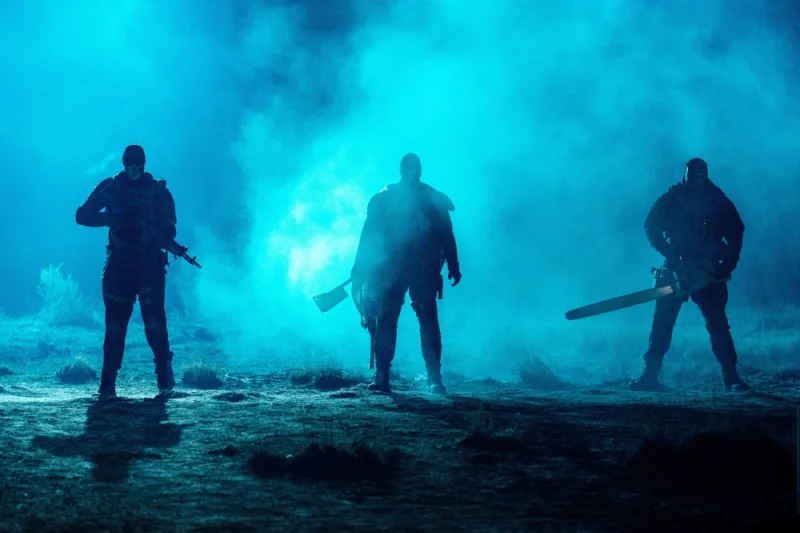
A24’s Onslaught arrives as Adam Wingard’s sharpest return to lean genre filmmaking since his two Godzilla vs. Kong movies, with Adria Arjona at the center as Celeste, a former sniper who runs a trailer park for U.S. army veterans. The 92-minute thriller pushes her from domestic routine into a military-infused slasher run of violence, with a 12-hour clock driving the action toward an inevitable massacre.
That countdown matters because the film is built to feel like pressure. Celeste’s day breaks open when her ex-husband drops off Daisy, then the nearby military events start closing in, and the story keeps tightening until the action reaches her stronghold. Arjona plays Celeste as rankled and hard-as-nails, but she lets warmth surface when the character turns protective and maternal, which gives the performance a pulse the movie keeps leaning on.

The opening makes the film’s scale clear before the bloodshed takes over. Onslaught begins with a montage moving backward through several American wars and into Operation Paperclip, where Dan Stevens’ heavily made-up Dr. Hans Kammler talks through torturous methods for building human weapons. At least two of those super-soldiers are Black, and the third is kept from view, a choice that turns the film’s history lesson into something stranger and uglier than a standard villain reveal.
Wingard and Simon Barrett have said enough with bigger studio machinery and gone back to the kind of elevated genre work they made before, and that is where Onslaught feels most alive. It is stylish, noisy and often fun, and it keeps circling the same dark joke that powered The Guest: a polished surface hiding a nasty appetite. Rebecca Hall gives Hanna a domineering edge opposite Kammler, while Drew Starkey, Reginald VelJohnson and Eric Wareheim fill out the collision around Celeste.
Still, the movie never fully shakes the sense that it could use one more pass. Its pieces fit late rather than cleanly, and the mix of war history, slasher set pieces and social unease is more ambitious than refined. The result is an aesthetically accomplished film that feels unfinished in places, which is a frustrating note to land on for a story this confident in its own shape. By the time the countdown ends, the question is not whether Onslaught is strong enough to hold attention. It is whether Wingard’s return to smaller-scale filmmaking is now the path that best fits him.