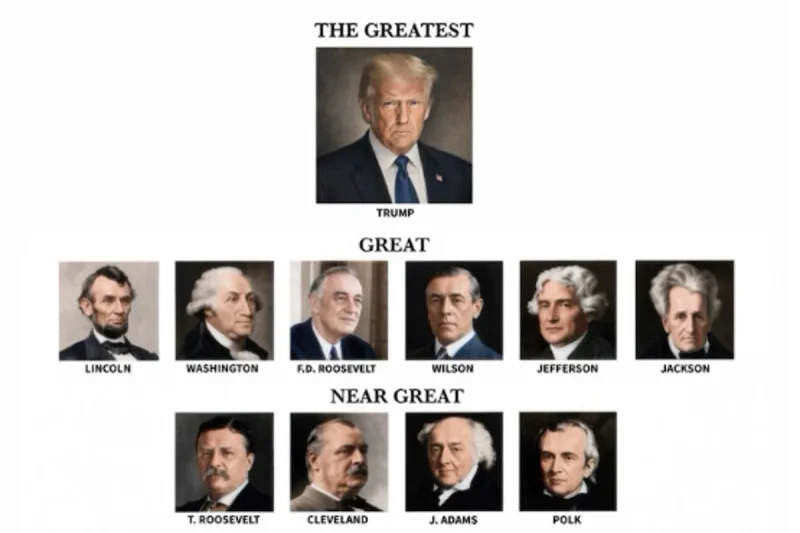
President Trump shared a chart on Thursday ranking the best U.S. presidents and put himself in the top spot, above George Washington and Abraham Lincoln. The move put his own judgment on display at a moment when his standing with the public remains weak.
The chart landed just as a poll found that 53 percent of GOPers named Trump as the Republican president they admire the most, ahead of Lincoln and Ronald Reagan. That helps explain why a ranking like this can travel so far inside his political world even as it looks jarring outside it.
Trump’s choice was not a neutral history exercise. Mike Rothschild said the chart was based on a Life Magazine chart from 1948, with Trump’s name added at the top and the Democrats he does not like pushed to the bottom. In other words, the list was built to flatter him before it was ever shared.

The contrast is blunt. In a 2024 survey of historians and political scientists, Trump finished at the bottom, while Joe Biden was listed at number 14. Michael Bailey was even more direct, calling Trump easily the worst president in U.S. history and saying the damage to long-term institutions and the country’s reputation goes far beyond anything seen before.
Christopher W. Jones said Trump apparently has no opinion on where Ronald Reagan and George W. Bush rank as presidents, a remark that fits the odd shape of the chart itself. Their absence is as telling as Trump’s self-promotion: he did not just place himself ahead of the nation’s most celebrated presidents, he also skipped over recent Republican predecessors entirely.
That pattern matches how Trump has handled presidential history before. During his second term, he installed a presidential Walk of Fame at the White House, featuring portraits of his predecessors and descriptions of their achievements, only for historians to say the plaques were highly partisan and often inaccurate. One historian compared the scholarship behind them to drawing mustaches on other people's portraits.
Trump’s approval rating hit rock bottom last week with the support of just one-third of Americans, which makes the chart less a measure of national consensus than a statement of self-belief. The unresolved question is not where historians place him; it is how long he will keep turning presidential history into a mirror.