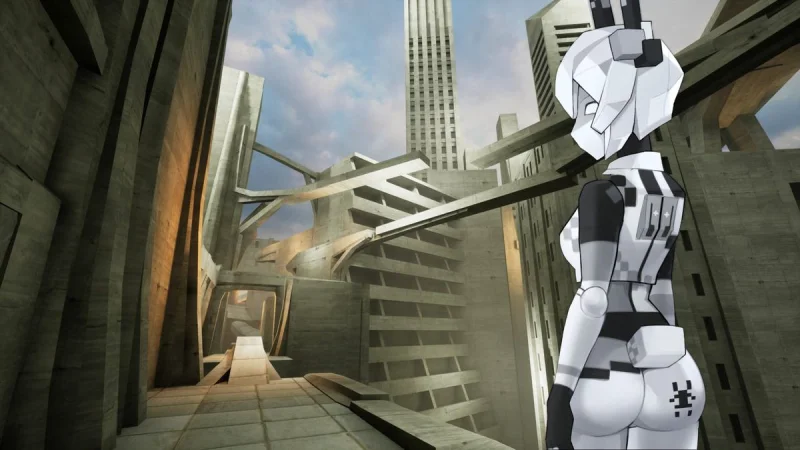
VHOLUME has arrived as a fuller release, turning its demo-era promise into a brutalist parkour runner built around speed, repetition and cleaner routes. The game gives players a compact set of verbs — run, crouch, slide, wall crawl, climb and jump — then asks them to use those tools to shave seconds off every stage.
That is the hook now because VHOLUME and CICADAMATA dropped at the same moment, putting two cheap indie releases into a crowded season and making quick-read discovery part of the appeal. VHOLUME costs eight dollars, while CICADAMATA is nine, and VHOLUME leans hardest into the kind of movement game that rewards players who want to run a stage again and again until the line feels perfect.

The comparison points help explain the design. VHOLUME is being measured against Mirror’s Edge, Counter-Strike Surf and Titanfall 2’s gauntlet level, a useful shorthand for anyone who wants movement to matter as much as combat or story. Its stages are built for route optimization, not slow exploration. Bunny hopping is fast, the quickest way across a straight line can involve hopping and sliding, and the game even lets players keep climbing a wall almost endlessly by holding forward, looking up, letting go for a beat, jumping, and repeating the motion. That sort of system does more than make the game quick; it turns movement into the puzzle.
Leaderboards make that puzzle public. Each stage tracks a player’s time, saves a ghost run, and lets anyone replay it later, while a single button can reset an entire area so another attempt starts immediately. That structure is what gives the game its replay value and why the demo drew so much attention when it first appeared: the basic loop already looked complete, even before the fuller release added more levels beyond that first showing. The exact number of stages is not stated, but the point is clear enough from the design itself. VHOLUME is no longer just a tease. It is a complete time-trial playground with more room to master.
There is one wrinkle. VHOLUME is described as having little in the way of a formal plot, even though it does include cryptic narrative encounters. That keeps the focus where the game clearly wants it: on movement, mastery and the compulsion to improve a run that already feels fast. The result is a release that asks for practice first and interpretation later, and for the people who want parkour to be the main event, that may be exactly enough.