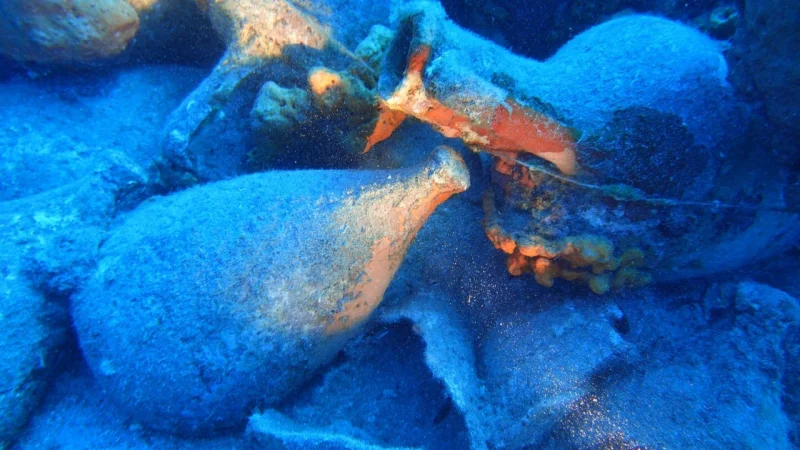
A diver off Sardinia found a flash of metal in seagrass near Arzachena on May 25, 2023, and what followed was not a single coin but one of the largest marine finds of late Roman bronze folles in recent years. Italy’s culture ministry said the recovery grew to more than 30,000 coins and could have reached 50,000, with fragments of narrow-necked amphorae scattered across the same stretch of seabed.
The discovery matters today because the site still sits between two readings: a buried loss from a wreck, or a different kind of underwater deposit whose meaning has never been fully pinned down. The ministry treated a wreck as a possibility, and its own description of the coins as being in excellent, rare condition only sharpened the question of how they came to rest there.
Luigi La Rocca called the treasure found in the waters of Arzachena one of the most important numismatic discoveries in recent years, and added that it showed how much of Italy’s seabed still holds from earlier traffic of people and goods. That scale alone made the find unusual. The coins were found across two large areas of dispersion between the beach and Posidonia seagrass, a pattern that invited recovery work and closer study rather than a simple collection of loose objects.

Teams from Italy’s art-protection police, the ministry’s underwater archaeology office, firefighters and border police joined the effort after the diver contacted authorities. The original statement dated the hoard between 324 and 340 CE, while a December 2023 presentation in Sassari said a studied sample ran from 324 CE to no later than 345 CE and used roughly 40,000 folles as a working figure. The coins, first used by the Romans and later by the Byzantine Empire, were being read not as a random scatter of change but as a hoard with a very specific late antique horizon.
Even so, the wreck question has never been fully settled in public. The coin scatter and amphora fragments could fit a ship loss, but the available record stops short of confirming one, and that gap matters because the legal and archaeological readings are not the same. On January 5, 2026, TAR Sardegna rejected the finder’s claim for a statutory reward and said the discovery was not fortuitous, citing the use of a metal detector and evidence that the area was already understood as potentially archaeologically significant.
By May 2026, the hoard was still not on display, even though reporting from a December 2023 public presentation said part of the cleaned and cataloged material was expected to go to Arzachena’s civic museum. That leaves the find in an odd place: recovered, studied and legally contested, but still not fully interpreted. For now, the seabed off Sardinia has yielded a major cache, not a final answer.