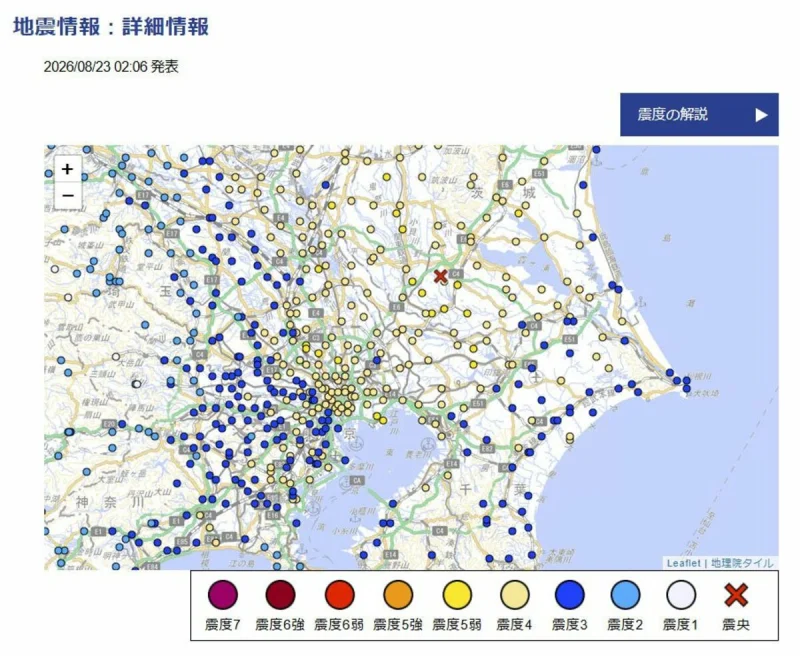
A magnitude 5.9 earthquake struck Tokyo and the wider Kanto region on Sunday, injuring at least 37 people and knocking trains off schedule as the ground shook for up to a minute in some areas. Tokyo’s Adachi Ward recorded lower 5 shaking, while parts of Ibaraki, Saitama and Chiba also felt the same level.
The quake was centered in southern Ibaraki Prefecture at a depth of 68 kilometers, and mobile phones sounded earthquake early warning alarms shortly before the shaking began around 2 a.m. The impact spread beyond one city or one line. JR East reported delays across several routes on Sunday morning, including the Joban Line, Keihin Tohoku Line, Shonan Shinjuku Line, Musashino Line and Chuo-Sobu Line.

The injury count gave the quake its immediate weight. The Fire and Disaster Management Agency said 22 people were lightly hurt in Saitama, Chiba, Kanagawa and Ibaraki prefectures, while 15 were injured in Tokyo. One person in Kanagawa was seriously injured. Officials also reported a partial collapse of the ceiling at Ushiku City Hall in Ushiku, Ibaraki Prefecture, and there were reports of people trapped in elevators in Tokyo.
Sanae Takaichi said within an hour of the quake that efforts to confirm the extent of the damage were still under way and that a liaison office had been set up at the Prime Minister’s Office Crisis Management Center. She also said officials had been instructed to provide timely and accurate information and told people in areas where the shaking was strong to stay alert for another earthquake of similar magnitude.
That warning matters because lower 5 on Japan’s seven-point shindo seismic scale can make objects fall from shelves and force people to grab hold of something to keep their balance, according to the Japan Meteorological Agency. Level 2 long-period ground motion was also observed in Tokyo’s 23 wards, as well as Saitama and Chiba, a reminder that the shaking was not only strong but sustained enough to make taller buildings sway. For now, the damage tally is still being confirmed. What is already clear is that this was not a brief morning jolt. It was a widespread quake with injuries, transport disruption and the kind of aftershock risk that keeps a region on edge for days, not minutes.