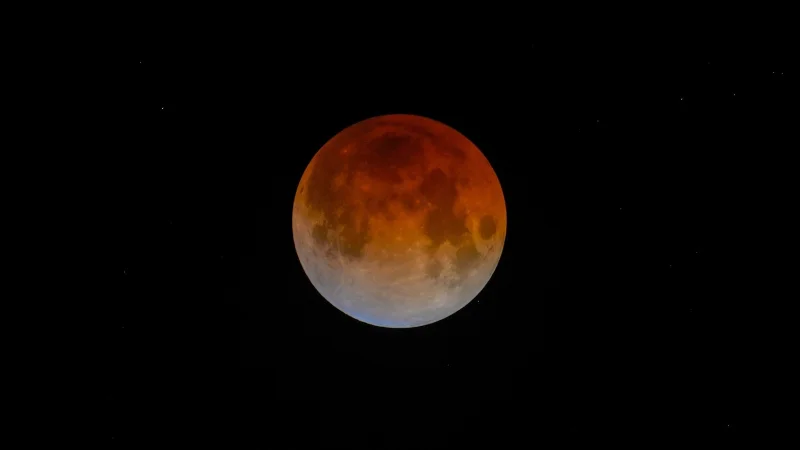
A near-total lunar eclipse will unfold Thursday night into Friday, covering 96% of the moon and leaving almost the entire lunar surface darkened for observers in the Americas. The partial eclipse will last more than three hours, and the whole event will run 5 1/2 hours, peaking just after midnight EDT.
That timing matters because the Americas are in the best position to see the full show. Nearly 1 billion people in the U.S., Canada, and Central and South America will have front-row views for the entire eclipse if skies are clear, while more than 3 billion people, or 44% of the world’s population, will be able to catch at least part of it. For viewers in Europe, Africa and the Middle East, the eclipsed moon will be setting, while it will be rising in Hawaii.
The event is drawing attention because it is not just deep, but unusually deep: a partial lunar eclipse with 96% of the moon masked. That still falls short of a true blood moon, since the moon will not be in perfect lineup, but the geometry is close enough to make the sky look nearly swallowed whole. It is the year’s second lunar eclipse and the fourth eclipse overall, coming two weeks after a total solar eclipse that crossed Greenland, Iceland and Spain.
Jack Hathaway, speaking last week from the International Space Station, called it a reminder of how quickly the space program is moving. “This is a great time to be part of the space program, right? We’re not slowing down,” he said. Jessica Meir has also described space as offering a “unique perspective” for seeing events like eclipses, a view that fits a moment when NASA is pushing ahead with Artemis II and broader lunar ambitions.
The catch is that this one is still only partial, even if it is a deep one. The moon will not pass through the perfect alignment needed for a total lunar eclipse, and that keeps it from becoming the full blackout many skywatchers wait for. The next complete lunar blackout will not come until New Year’s Eve 2028, though another full eclipse of the moon will be visible across North and South America in 2029.
For people who miss this week’s peak, there is no easy repeat on the calendar. This is the kind of eclipse that rewards a clear sky and the right clock, and for much of the Americas, Thursday night into Friday will be the moment to look up.