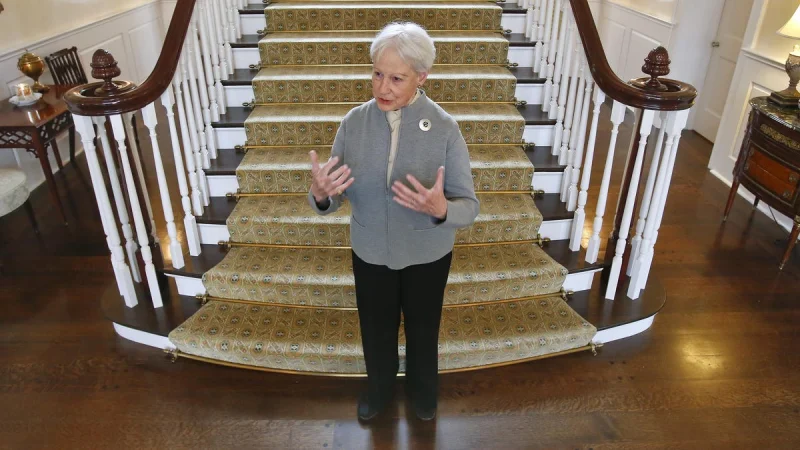
Nancy Landon Kassebaum Baker, the first woman to represent Kansas in the U.S. Senate, died on Aug. 21, 2026, at age 94, her family said. Her death closes the life of a politician who spent 18 years and 11 days in the Senate and left as one of Kansas’ most durable national figures.
For many Kansans, her name still carried the weight of firsts. She entered the Senate on Dec. 23, 1978, and became the only woman in the 100-member chamber during the first two years of her career. She was also the first woman elected to a full Senate term who did not reach office by succeeding her husband in Congress, a distinction that set her apart long before gender parity became a routine political talking point.
William Kassebaum, who lives in Burdick and is an attorney, rancher and former Kansas House member, is among those left to mourn her. He and John Kassebaum Jr. survive her. Her family said a private memorial will be held later.

Kassebaum’s political identity was built on independence as much as party label. A Republican, she was known as a moderate who did not always line up neatly with her party, and she focused on the budget deficit, international arms control, changes to liability laws tied to general aviation and ending apartheid in South Africa. That mix helped define why she stood out in the Senate: she was conservative enough to win in Kansas, but willing to break with her side when she thought the issue demanded it.
Born Nancy Josephine Landon on July 29, 1932, in Topeka, she came from a political family that had already been visible in Kansas life for decades. She was the daughter of Alf Landon and Theo Cobb Landon, graduated from Topeka High School in 1950 and earned a bachelor’s degree in political science from the University of Kansas in 1954. She met her future first husband, John Philip Kassebaum, there, then married him in 1955 after a year as a receptionist at Hallmark Cards.
In a 2017 interview for the Women of the Senate Oral History Project, she said people were curious to see a woman senator and that the attention sometimes helped her. She also said she believed she could contribute something and had something to offer. That confidence carried through a career that lasted nearly two decades and made her the standard for what a Kansas woman could do in national politics.
Her final years were spent in a century-old stone house on her ranch in Burdick. She was preceded in death by Howard Baker, Richard Kassebaum, Linda Kassebaum Johnson and John Philip Kassebaum. The family has not said what caused her death, leaving that detail unaddressed even as the record of her public life is complete.