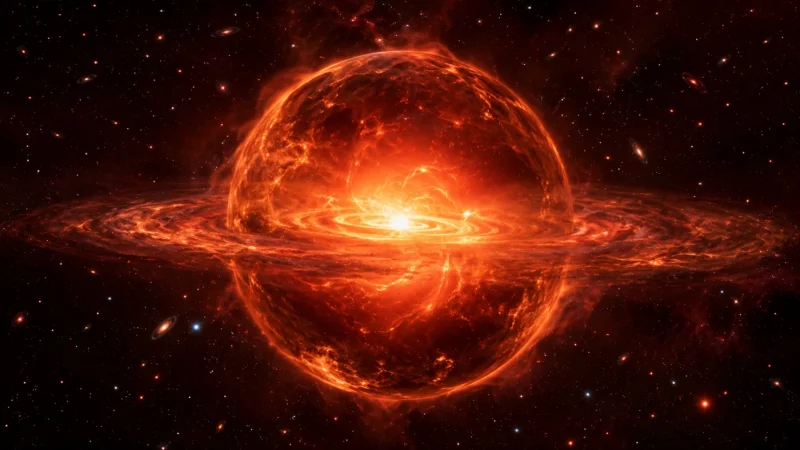
Astronomers led by Rohan Naidu have confirmed a strange object in the early universe that looks like a star from the outside but behaves like an active black hole from within. The finding, published in Nature, centers on MoM-BH*-1, a source first picked out in James Webb images as an unusually bright red dot.
The timing matters because James Webb has turned up thousands of the so-called small red dots since 2022, and this one may be the clearest sign yet that some of them are not ordinary stars at all. MoM-BH*-1 was found in a universe only 660 million years after the Big Bang, when the cosmos was still young enough that its most extreme objects were just beginning to take shape.
Naidu’s team, working with MIT and Universidad de Hawái, traced the object through its light and found a drop so deep at one point in the spectrum that a normal star could be ruled out. The key was the Balmer break, the signature that appears when hydrogen absorbs ultraviolet radiation around 364.6 nanometers to become ionized. In MoM-BH*-1, that light has been stretched by cosmological redshift into more than 2,700 nanometers by the time it reaches us. That shift is not a minor correction. It is the difference between seeing a nearby ultraviolet feature and detecting it in the infrared by James Webb.

The object itself is about the size of our solar system, but it gives off energy 100,000 million times greater than an average star. At its center sits an active black hole about 100,000 times the mass of the Sun, wrapped in a thick envelope of hydrogen and helium that fills the system. The black hole is feeding on surrounding matter at a furious rate, heating the gas to extreme temperatures and driving a glow that no conventional star can match.
That is where the contradiction becomes impossible to ignore. A normal star makes its own power through nuclear fusion in its core. MoM-BH*-1 instead appears to shine because a black hole is doing the work, while the dense outer gas gives it the shape of something starlike. The result is a system that breaks the usual rules of stellar behavior without looking, at first glance, like anything unusual at all.
For astronomers chasing the origin of giant black holes, the payoff could be large. If MoM-BH*-1 is not alone, it may be the first confirmed example of a broader population of star-like black hole systems hidden among the red dots James Webb has already found. That would help explain how some black holes reached billions of solar masses within the first 700 million years of the universe. The next step is straightforward and hard at the same time: find more objects like MoM-BH*-1 and determine whether this was a one-off oddity or a common way for the early universe to build monsters fast.