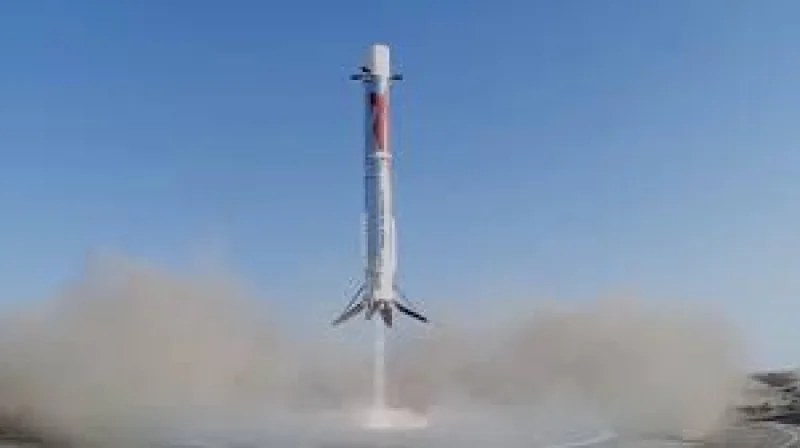
LandSpace landed the first stage of its Zhuque-3 rocket on a pad in northwest China on Tuesday, becoming the first Chinese company to recover an orbital-class booster on land. The move put the Chinese launch firm in a small but real club that has long belonged to SpaceX alone.
The landing mattered because it came on the vehicle’s second-ever flight, and the upper stage still delivered satellites to orbit. That combination, a recovered booster and a working payload mission, is what launch buyers and investors watch when they talk about reusable rocketry. It also helps explain why SpaceX shares fell 2.6% on the same day, as traders weighed the Chinese milestone against a fresh batch of stock becoming eligible to change hands.
For years, SpaceX has been the standard that rivals measure themselves against. It has landed boosters more than 600 times since 2015, giving it an operational lead that is still enormous even after Tuesday’s result. LandSpace’s success does not erase that gap, but it does show that booster recovery is no longer a one-company trick.

The numbers underline the distance that remains. Zhuque-3 stands 216 feet tall and can lift 40,350 pounds to low Earth orbit, while Falcon 9 is 230 feet tall and can lift 50,265 pounds. That means SpaceX’s rocket is about 6.5% taller and can carry about 24.4% more payload, a margin that still leaves it ahead on both size and lifting power. Even so, LandSpace’s landing suggests the race is tightening, especially for customers looking at launch reliability, reuse and price together.
LandSpace’s progress is sharper when set against its own setback. Its December 2025 debut reached orbit but lost the booster during descent after abnormal combustion, so Tuesday’s landing was the missing proof point rather than a simple repeat. The company did what it failed to do on the first try, and it did it on land, which is the cleaner and more commercially useful form of recovery.
SpaceX investors had another reason to stare at the tape. Around 319 million shares held by early employees and investors become eligible to trade on Thursday, and the Day 70 tranche will eventually release about 88% of SpaceX’s 13 billion shares through 2027. On Aug. 6, up to 911.5 million shares became tradable and the stock rose 6%, but that earlier unlock did not stop the latest slide from reminding holders that the supply overhang is still there. A 1.3 billion-share tranche is also set to unlock around SpaceX’s third quarter earnings in early November, while Elon Musk’s 6.42 billion shares stay locked until June 2027.
Pras Subramanian of Yahoo Finance has been tracking both the launch race and the market reaction, and the overlap is obvious: LandSpace just made the competitive field a little less lopsided, while SpaceX shareholders are entering another stretch where every unlock matters. The unanswered question is not whether SpaceX still leads. It does. It is how much more often Chinese launch companies need to land boosters before Wall Street starts treating the gap as a business problem, not just a technical one.