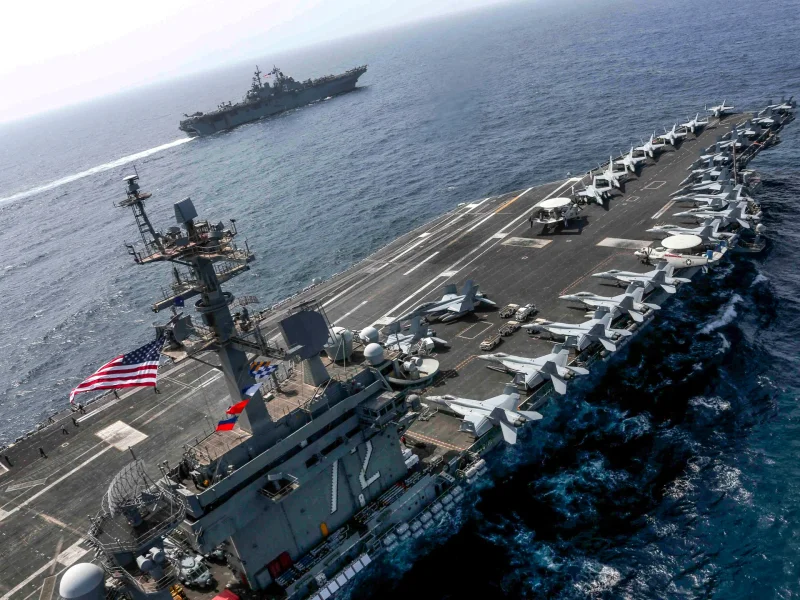
Reports of poor conditions aboard the USS Abraham Lincoln have turned a long deployment into a new test of Navy readiness. Crew morale problems, shortages of basic supplies and maintenance issues have all been reported as the carrier remains at sea longer than any previous ship without a port stop.
The ship has been deployed since November 2025, which means it has now been away for roughly 326 days if measured against the later May rotation of the USS Gerald Ford. That length of time is why families, lawmakers and naval analysts are focused on the USS Abraham Lincoln conditions now, not months from now. The carrier has become a symbol of what happens when a major deployment stretches on in the middle of a war that is still grinding on.
The reported shortages were not abstract. Family members told US media that loved ones on board had faced troubling instances of personnel attempting to jump overboard, a detail that sharpened concern about the strain on sailors. The same reports also described missing basic supplies on board, though no public accounting has said exactly which items ran short. The ship's status has since fed a broader argument about whether the Navy can keep major forces supplied and functioning when operations are this far from support.

That argument is now tied to strategy as much as to shipboard life. A widely circulated New York Times report linked supply shortages to Iranian attacks on US military sites in the Middle East, and a US military official told the newspaper that the Navy has been forced to use Diego Garcia as its main supply hub. Diego Garcia is about 3,540km, or 2,200 miles, from where the USS Abraham Lincoln and the USS George HW Bush have been operating near Iran, a distance that makes routine resupply slower and harder to manage.
In Washington, DC, the complaints have already reached Congress. A letter published on Tuesday said the circumstances leave both Congress and the public concerned that the Department is not adapting quickly enough to conditions in the CENTCOM area of responsibility. Democratic lawmakers said similar conditions had been reported on the USS Gerald Ford and the USS Abraham Lincoln during the Trump administration's leadership during the war, and Bradley Martin, a naval expert, said the end state is that readiness issues will emerge because the Navy has limits even as it is expected to project power and fill gaps.
Alexandru Hudisteanu said the episode underscores the burden of US global power projection built around naval capacity and 11 active aircraft carriers. He also noted that carrier strike groups typically include one cruiser, four to six destroyers, 75 aircraft and 7,500 sailors and US Marines, a force package that is difficult to sustain when a deployment keeps stretching and the supply line grows longer. The reported USS Abraham Lincoln conditions are a warning sign, and the next question is not whether the strain exists but how long the Navy can keep absorbing it before more ships and crews feel it too.