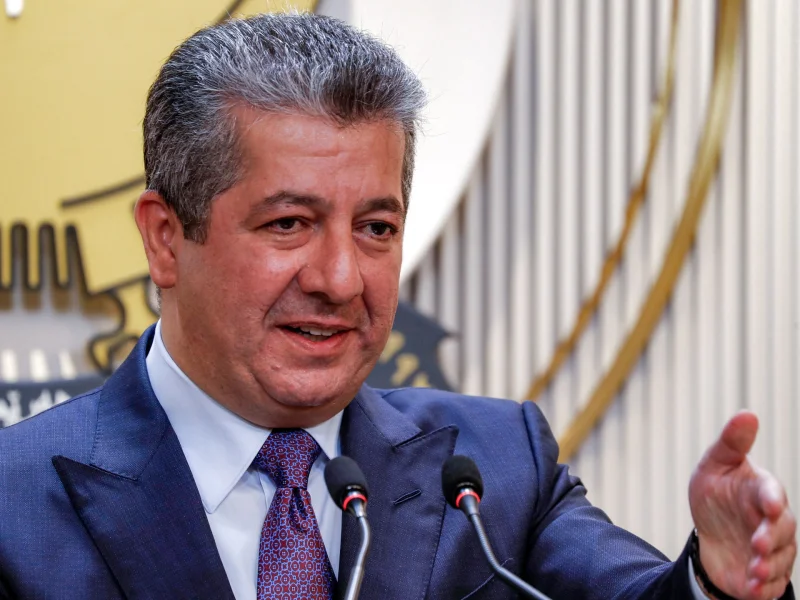
Two drones struck the office of Masrour Barzani and the home of the Kurdistan Region’s intelligence chief in northern Iraq on Monday, setting off a dispute over who sent them and why. The Kurdistan Regional Government security agency said the attack was launched from Iranian territory.
The strike landed in a place already on edge. Readers were searching for Kurdistan because the attack came days after a report that the Trump administration had used Nechirvan Barzani as a back channel to speak with Ahmad Vahidi, a disclosure later confirmed to Iran International. That sequence gave Monday’s attack a sharper political edge: it was not just a security breach, but a blow that arrived in the middle of a sensitive line of contact.
Abbas Araghchi tried to shut down the blame early. On X, Iran’s foreign minister said Kurdish friends should beware of false-flag ploys meant to sow discord between neighbors. Esmail Baghaei used similar language, calling the development highly suspicious and saying he had information suggesting Iraqi intelligence was holding groups responsible for planning and carrying out sinister plots.

But the technical detail at the center of the case cuts against that framing. Roger Macmillan said the Kurdistan Counter-Terrorism Service identified two Hadid-110 drones and placed the launch point inside Iranian territory. He called that a forensic claim, not a political one, and argued that any false-flag theory would have to explain how a third party sourced and launched that type of drone from inside Iran itself. Araghchi’s statement, he said, never answers that point. It simply labels the attack suspicious and shifts attention elsewhere.
The friction is harder to ignore because Araghchi has used the same language before. In March, he warned his Turkish counterpart about repeated false-flag operations aimed at undermining regional ties, and only weeks ago he described a drone strike on Egypt’s Damietta Port as an Israeli false-flag operation. That pattern gives his response a familiar shape, even as the KRG says the attack on Monday began from inside Iran.
Erbil has faced frequent attacks from Iran since the war began, and the scale of pressure on Kurdish groups has been far larger than one drone strike. A Democratic Party of Iranian Kurdistan report seen by The Jerusalem Post said the IRGC and affiliated groups carried out 423 attacks on five Kurdish organizations between February 28 and August 1, causing 20 casualties. The same pattern is part of the backdrop here, along with past reporting on Ardalan Mama, whose home was destroyed by an Iranian missile. For now, the unanswered question is not whether the attack was serious. It is whether the competing explanations are a cover for a wider message to the KRG, or the start of a case that will harden relations further.