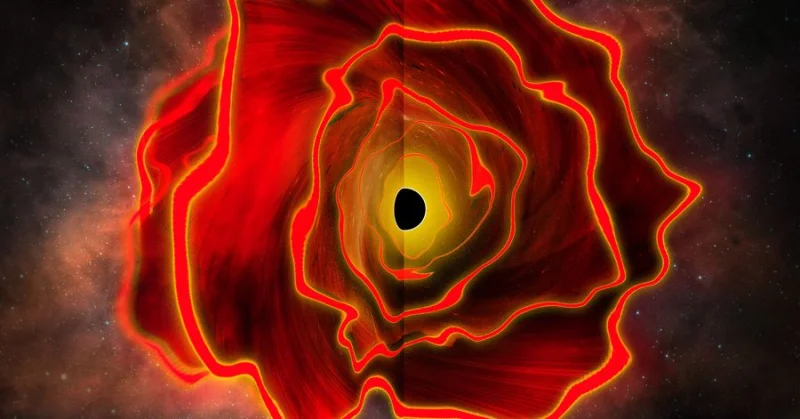
A new paper in Nature says MoM-BH*-1 may be a black hole star, a strange early-universe object that looks like a star but may be powered by a black hole at its core. The signal from the source dates to a time when the universe was 660 million years old, and researchers say it was bright enough to stand out as one of the James Webb Space Telescope’s reddish points of light.
The timing is what makes the finding matter now. On Wednesday, the team laid out its case using James Webb Space Telescope observations, adding a fresh answer to the growing list of explanations for the small red spots the telescope has been finding in the distant universe. Rohan Naidu said every little red dot is consistent with being a black hole star embedded in a generic early galaxy, but he singled out MoM-BH*-1 as unusual because it is essentially completely outshining its surrounding host galaxy.

That claim turns on a simple but unsettling mismatch. The team says MoM-BH*-1 emits about 100 billion times more energy than any star could produce through nuclear fusion. To make that work, the hypothesis puts an enormous black hole at the center, devouring matter and releasing energy, while a massive shell of extremely dense gas wraps around it. The gas would absorb part of the light and reshape the rest as it escapes, so the object can still resemble starlight even if its engine is not a star at all.
That is also why MoM-BH*-1 is so hard to classify. It looks like a bright reddish spot in the early universe, but the energy output and the way light appears to be absorbed are too extreme to fit normal star behavior. Researchers have floated other explanations for these red spots too — compact galaxies packed with stars, black holes buried in dust, or systems unlike anything seen today — and the black hole star idea is another attempt to explain why JWST keeps finding objects that do not fit neatly into familiar categories.
For now, MoM-BH*-1 is interesting less because it closes the case than because it sharpens the question. If the black hole star reading holds, it would mean JWST has found a new kind of object from the universe’s youth, one that can outshine its own galaxy while hiding its true engine behind gas. The next step is not a slogan or a guess; it is whether the same pattern shows up clearly enough in more data to rule out the other explanations and turn a provocative model into a settled finding.