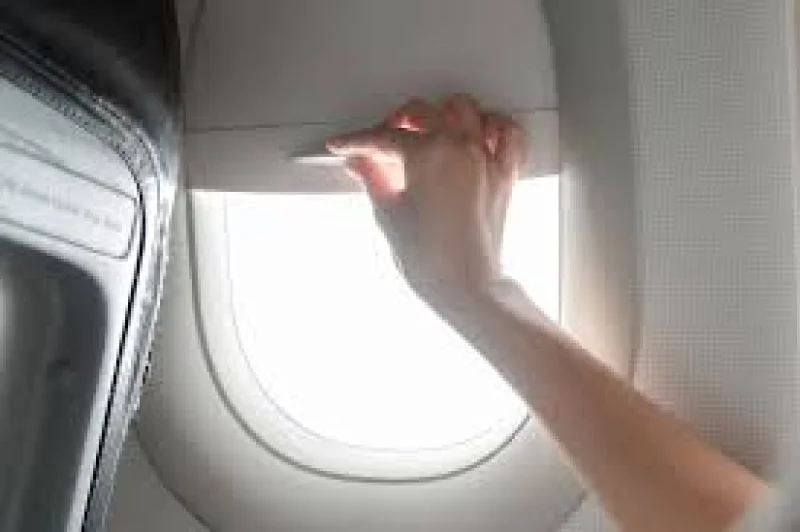
A flight attendant may ask passengers to open an airplane window shade during takeoff or landing, and the reason is blunt: those are the moments when crews have the least time to react if something looks wrong outside.
Near the ground, the margin for error is thin. Other planes can be moving nearby. Ground vehicles may be close to the aircraft. On rare occasions, animals can be on the runway. With the shade open, someone inside can spot smoke, a stray spark near the engine, ice on the wing or a tire problem before a small issue turns into a bigger one. If the shade stays closed, a problem can go unnoticed until there is little left that can be done about it.
That is why the International Air Transport Association recommends open shades as a safety best practice during takeoff and landing. The idea is simple: an open view gives crew members and, when needed, first responders a faster look at what is happening outside. It can also matter once a flight stops. Fire, debris or water may be easier to see before anyone opens a door, and eyes can take a few seconds to adjust when moving between a dim cabin and bright daylight, or the other way around.

But the rule is not the same everywhere. In the United States, the FAA does not require open shades, which leaves individual airlines to decide whether to enforce the practice. That is why passengers may hear the instruction on one flight and not on another, even when the aircraft is doing the same thing. International carriers tend to enforce it more strictly, while U.S. airlines have their own policies.
United has made open shades official policy in recent years, turning what can feel like a casual request into a clear safety expectation. For passengers, the instruction is easy to ignore because it seems minor. For crews, it is a fast check that can save seconds when seconds matter most.
The answer to why the practice appears and disappears is straightforward: the safety logic is widely accepted, but in the United States enforcement is still left to airlines. That means the open airplane window may be treated less like a universal rule than a company-by-company decision, even though the hazard it is meant to catch can come and go in an instant.